MCAT Enzyme Practice Questions with Answers

MCAT Enzyme Practice Questions with Answers
Mastering enzyme kinetics and regulation is a cornerstone of success for any pre-medical student. This MCAT Enzyme guide provides a deep dive into the catalytic power of proteins, offering comprehensive explanations and challenging practice problems to sharpen your skills. Whether you are calculating Michaelis-Menten parameters or identifying types of inhibition, these resources will help you secure those high-yield points on the Biological and Biochemical Foundations of Living Systems section.
Concept Explanation
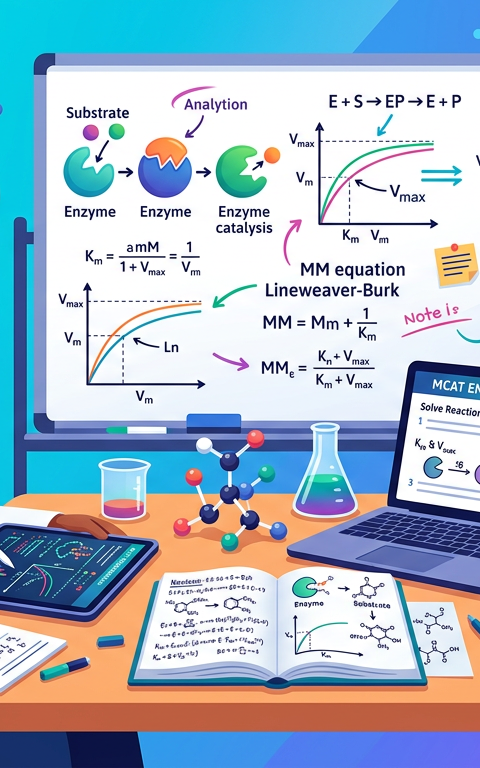
Enzymes are biological catalysts, primarily proteins, that increase the rate of chemical reactions by lowering the activation energy without being consumed in the process. They achieve this by stabilizing the transition state of a reaction within a specific region known as the active site. The study of enzyme behavior often centers on Michaelis-Menten kinetics, which describes the relationship between the reaction velocity and the substrate concentration . Key parameters include the maximum velocity and the Michaelis constant , which represents the substrate concentration at which the reaction velocity is half of its maximum. On the MCAT, you must also understand how different inhibitors affect these parameters. For instance, competitive inhibitors increase but leave unchanged, while noncompetitive inhibitors decrease without affecting . Enzymes also rely on cofactors and coenzymes to function, and their activity is tightly regulated through feedback loops and allosteric sites. Understanding these principles is as vital as mastering Easy MCAT Kinetics Practice Questions in general chemistry.
Solved Examples
Review these detailed walkthroughs to understand the logic required for complex enzyme calculations and conceptual applications.
- Calculating Catalytic Efficiency: An enzyme has a of and a of . What is the catalytic efficiency of this enzyme?
- Identify the formula for catalytic efficiency: .
- Plug in the given values: .
- Perform the division: .
- Final Answer: The catalytic efficiency is .
- Lineweaver-Burk Plot Analysis: A researcher finds that a new drug shifts the x-intercept of a Lineweaver-Burk plot from to but keeps the y-intercept at . What type of inhibition is occurring?
- Recall that the y-intercept is . Since the y-intercept is unchanged, is unchanged.
- Recall that the x-intercept is . The original was . The new is .
- Since increased and remained constant, the inhibitor is competitive.
- Final Answer: Competitive Inhibition.
- Hill Coefficient Interpretation: An enzyme displays a Hill coefficient of . What does this indicate about its binding behavior?
- Note that a Hill coefficient indicates positive cooperativity.
- This means that the binding of one substrate molecule increases the affinity of the enzyme for subsequent substrate molecules.
- This often results in a sigmoidal (S-shaped) saturation curve rather than a hyperbolic one.
- Final Answer: The enzyme exhibits positive cooperativity.
Practice Questions
Test your knowledge with these MCAT-style questions. Ensure you are also comfortable with related topics like Medium MCAT General Chemistry Practice Questions to build a strong foundation.
1. Which of the following is true regarding the active site of an enzyme?
2. A reaction has a of . If the substrate concentration is equal to the , what is the initial velocity ?
3. How does a noncompetitive inhibitor affect the Lineweaver-Burk plot?
Your MCAT prep should adapt to you.
Bevinzey analyzes your performance and helps you focus on the concepts you need most.
Try Adaptive Practice4. Which enzyme class is responsible for the movement of a functional group from one molecule to another?
5. An uncompetitive inhibitor binds to which of the following?
6. If the of an enzyme increases, what happens to its affinity for the substrate?
7. Which of the following describes a zymogen?
8. In the Michaelis-Menten equation, what does represent?
9. A scientist observes that an enzyme's activity increases as temperature rises up to but drops sharply at . What is the most likely cause of the drop?
10. Which amino acid is most likely to be found in the active site of an enzyme that uses acid-base catalysis at physiological pH?
Answers & Explanations
1. The active site is a small part of the total enzyme volume and provides a specific microenvironment. Enzymes are large proteins, but the catalytic activity is localized. The active site uses various intermolecular forces to stabilize the transition state, as explained by the Induced Fit Model.
2. 50 mmol/s. By definition, is the substrate concentration at which the reaction rate is half of . Using the Michaelis-Menten equation: If , then
3. It increases the y-intercept but does not change the x-intercept. Noncompetitive inhibitors bind to an allosteric site, decreasing (which increases , the y-intercept). They do not affect the binding affinity (), so the x-intercept () remains the same.
4. Transferases. These enzymes catalyze the transfer of groups (like phosphate or methyl groups) between molecules. Kinases are a famous subtype of transferases. This is distinct from isomerases, which rearrange groups within a single molecule, a concept often seen in MCAT Stereochemistry Practice Questions.
5. The enzyme-substrate (ES) complex only. Uncompetitive inhibitors do not bind to the free enzyme; they only bind once the substrate has already entered the active site, effectively "locking" it in and preventing product release.
6. The affinity decreases. and affinity are inversely related. A higher means more substrate is required to reach half-saturation, indicating a weaker attraction between the enzyme and substrate.
7. An inactive precursor of an enzyme that requires cleavage for activation. Examples include pepsinogen (becomes pepsin) and trypsinogen. This prevents enzymes from damaging the tissues where they are synthesized, such as the pancreas.
8. The turnover number. It represents the number of substrate molecules converted to product per enzyme molecule per unit of time when the enzyme is fully saturated.
9. Denaturation. High temperatures disrupt the non-covalent interactions (hydrogen bonds, hydrophobic effects) that maintain the protein's tertiary structure, causing it to unfold and lose its catalytic function.
10. Histidine. With a pKa of approximately 6.0, histidine's side chain can exist in both protonated and deprotonated states at physiological pH (), making it an ideal candidate for donating or accepting protons during catalysis.
1. Which of the following best describes the effect of a competitive inhibitor on an enzyme-catalyzed reaction?
Frequently Asked Questions
What is the difference between a cofactor and a coenzyme?
Cofactors are a broad category of helper molecules that include inorganic metal ions like or . Coenzymes are a specific subset of cofactors that are organic molecules, often derived from vitamins, such as NADH or FADH2.
How do enzymes lower activation energy?
Enzymes lower activation energy by creating an environment that stabilizes the transition state, such as through orienting substrates correctly, providing acid-base groups, or creating strain on specific bonds. This reduces the energy barrier required for the reaction to proceed, as described in Nature Education's enzyme overview.
What is the difference between reversible and irreversible inhibition?
Reversible inhibition involves non-covalent interactions that can be overcome by removing the inhibitor or increasing substrate concentration. Irreversible inhibition usually involves the formation of a covalent bond with the enzyme, permanently disabling it.
What does a Hill coefficient greater than 1 signify?
A Hill coefficient greater than 1 indicates positive cooperativity, meaning the binding of one ligand increases the affinity for subsequent ligands. This is characteristic of regulatory enzymes like hemoglobin (though technically a transport protein) and phosphofructokinase-1.
Why is Vmax independent of competitive inhibitors?
Competitive inhibitors bind only to the active site and can be outcompeted by very high concentrations of substrate. At infinite substrate concentration, the enzyme will still reach its maximum possible rate because all active sites will eventually be occupied by substrate rather than inhibitor.
Your MCAT prep should adapt to you.
Bevinzey analyzes your performance and helps you focus on the concepts you need most.
Try Adaptive PracticeReviewed by
Michael Danquah, MS, PhD
Dr. Michael Danquah is a professor of pharmaceutical sciences and founder of several educational technology platforms focused on improving student learning and performance.
Enjoyed this article?
Share it with others who might find it helpful.
Related Articles
Hard MCAT Enzyme Practice Questions
Hard MCAT Enzyme Practice Questions
May 14, 2026

Medium MCAT Enzyme Practice Questions
Medium MCAT Enzyme Practice Questions
May 14, 2026

MCAT Enzyme Kinetics: Solving KM and Vmax Without a Calculator
Easy MCAT Enzyme Practice Questions
May 14, 2026

Applying Coulomb’s Law and Potential to MCAT Biological Systems
MCAT Electrostatics Practice Questions with Answers
May 14, 2026

Hard MCAT DNA Replication Practice Questions
Master high-level DNA replication concepts with these hard MCAT practice questions covering enzymes, directionality, and telomeres.
May 14, 2026

Medium MCAT DNA Replication Practice Questions
Medium MCAT DNA Replication Practice Questions
May 14, 2026

Easy MCAT DNA Replication Practice Questions
Master DNA replication with these easy MCAT practice questions. Learn about helicase, polymerase, and semi-conservative replication with detailed explanations.
May 14, 2026

MCAT DNA Replication Practice Questions with Answers
MCAT DNA Replication Practice Questions with Answers
May 14, 2026