Hormone Regulation Questions Practice Questions with Answers
Concept Explanation
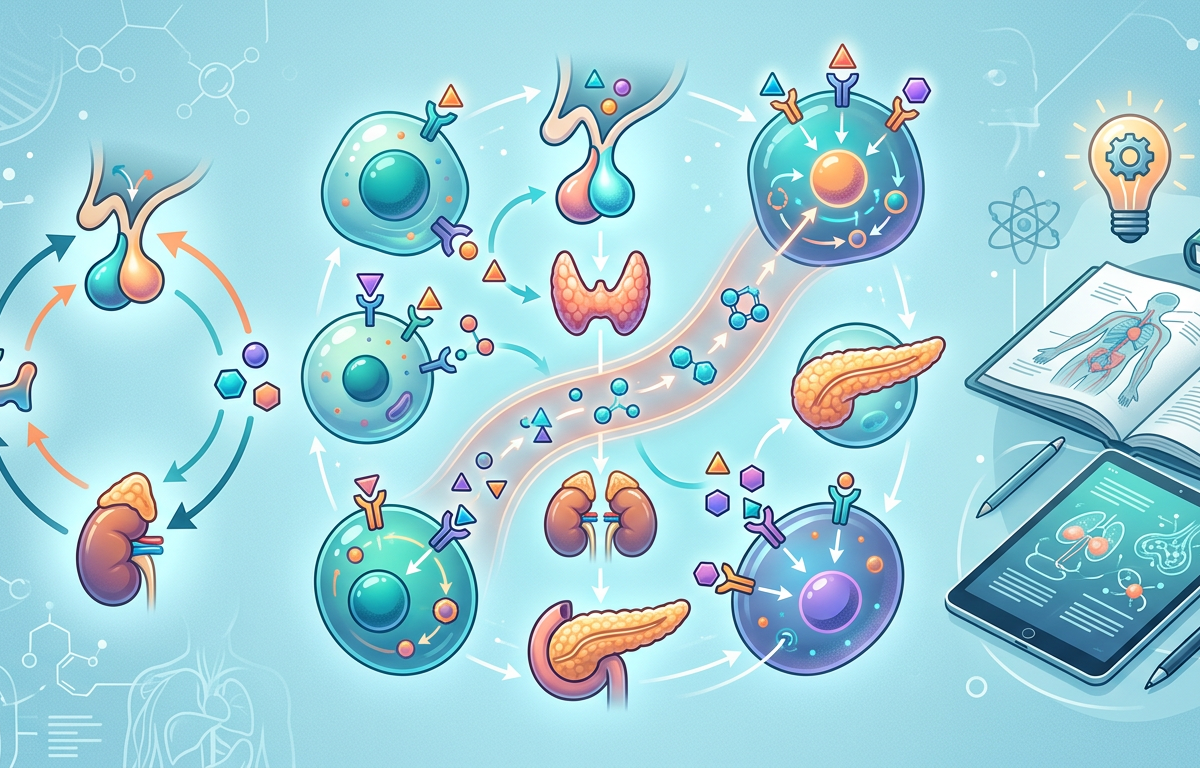
Hormone regulation questions often test the understanding of how the body maintains homeostasis through the endocrine system, involving the synthesis, secretion, transport, and action of hormones, as well as the feedback mechanisms that control their levels. Hormones are chemical messengers produced by endocrine glands that travel through the bloodstream to target cells, where they bind to specific receptors and elicit a physiological response. This intricate system ensures that various bodily functions, from metabolism to reproduction, are precisely controlled.
The primary mechanism for regulating hormone levels is negative feedback. In a negative feedback loop, an increase in a hormone's concentration or its effects inhibits further hormone release. For example, high levels of thyroid hormones inhibit the release of Thyroid-Stimulating Hormone (TSH) from the pituitary gland and Thyrotropin-Releasing Hormone (TRH) from the hypothalamus. Conversely, positive feedback loops are less common but exist, such as in childbirth where oxytocin release intensifies uterine contractions, leading to more oxytocin release until the baby is born. Understanding these feedback mechanisms is crucial for answering hormone regulation questions.
Hormones can be classified based on their chemical structure (e.g., peptide, steroid, amine) which influences their transport in blood, their receptor location (cell surface for water-soluble hormones, intracellular for lipid-soluble hormones), and their mechanism of action. The hypothalamus and pituitary gland form the neuroendocrine control center, orchestrating the release of many other hormones throughout the body. Disorders of hormone regulation, such as diabetes mellitus (insulin regulation) or hypothyroidism (thyroid hormone regulation), highlight the critical role these chemical messengers play in maintaining health.
Solved Examples
Here are some solved hormone regulation questions to illustrate key concepts.
Example 1: Negative Feedback in Thyroid Hormone Regulation
- Question: A patient presents with symptoms of weight gain, fatigue, and cold intolerance. Blood tests reveal low levels of T3 and T4, and high levels of TSH. Which part of the feedback loop is most likely malfunctioning?
- Solution:
- First, analyze the normal thyroid hormone regulation pathway: The hypothalamus releases TRH, which stimulates the anterior pituitary to release TSH. TSH then stimulates the thyroid gland to produce T3 and T4. High levels of T3/T4 inhibit TRH and TSH release (negative feedback).
- Next, interpret the patient's blood test results: Low T3/T4 indicates underproduction by the thyroid gland. High TSH indicates that the pituitary is trying to stimulate the thyroid, but the thyroid is not responding adequately.
- Conclusion: The thyroid gland itself is likely malfunctioning and unable to produce sufficient T3 and T4 despite strong stimulation from the pituitary (high TSH). This is a primary hypothyroidism. If the pituitary or hypothalamus were malfunctioning, TSH levels would likely be low or normal in the presence of low T3/T4.
Example 2: Insulin and Glucose Homeostasis
- Question: After a large meal, blood glucose levels rise. Describe the hormonal response that brings glucose levels back to normal.
- Solution:
- Identify the stimulus: Increased blood glucose levels.
- Identify the endocrine gland and hormone: The pancreas, specifically the beta cells, detect the rise in blood glucose.
- Describe the hormone release: The beta cells release insulin into the bloodstream.
- Describe insulin's actions: Insulin acts on target cells (e.g., muscle, fat, liver) to increase glucose uptake from the blood. It also promotes the conversion of glucose to glycogen for storage in the liver and muscles (glycogenesis) and the conversion of glucose to fat.
- Describe the outcome: These actions lower blood glucose levels, returning them to the normal homeostatic range. This is an example of negative feedback, as the reduction in blood glucose removes the stimulus for insulin release.
Example 3: Adrenal Gland Hormones and Stress Response
- Question: A person experiences a sudden stressful event. Explain the immediate hormonal response involving the adrenal glands.
- Solution:
- Identify the stimulus: Acute stress.
- Identify the glands and hormones: The sympathetic nervous system is activated, stimulating the adrenal medulla. The adrenal medulla releases catecholamines, primarily epinephrine (adrenaline) and norepinephrine (noradrenaline).
- Describe the physiological effects: These hormones prepare the body for 'fight or flight' by increasing heart rate, blood pressure, dilating bronchioles, increasing blood flow to skeletal muscles, and promoting glucose release from the liver (glycogenolysis).
- Note the speed: This response is rapid, occurring within seconds to minutes, due to direct neural stimulation of the adrenal medulla. For a more sustained stress response, the hypothalamus-pituitary-adrenal (HPA) axis would also be activated, leading to cortisol release from the adrenal cortex.
Practice Questions
Test your knowledge with these hormone regulation questions.
1. Which of the following is the primary mechanism by which the body regulates most hormone levels?
2. A patient is diagnosed with hyperthyroidism, characterized by elevated T3 and T4 levels. What would you expect their TSH levels to be, and why?
3. Describe the role of the hypothalamus and pituitary gland in integrating the nervous and endocrine systems.
4. Explain how steroid hormones exert their effects on target cells, distinguishing them from peptide hormones.
5. What would be the expected blood glucose and insulin levels in a person with Type 1 Diabetes Mellitus immediately after a meal, and why?
6. PTH (Parathyroid Hormone) increases blood calcium levels. Describe the feedback mechanism that controls PTH secretion.
7. A tumor in the anterior pituitary gland leads to excessive growth hormone (GH) secretion in an adult. What condition would this cause, and what are its characteristic symptoms?
8. How does the body regulate water balance through hormonal control, specifically involving ADH?
9. Discuss the concept of hormone specificity, including why a hormone only affects certain target cells.
10. Progesterone and estrogen levels fluctuate during the menstrual cycle. Describe how these hormones interact with the hypothalamus and pituitary to regulate the cycle.
Answers & Explanations
1. Negative feedback. This mechanism ensures that as hormone levels rise, further production and release are inhibited, thereby maintaining homeostasis.
2. In hyperthyroidism with elevated T3 and T4, you would expect TSH levels to be low. This is because the high circulating levels of T3 and T4 exert a strong negative feedback on the anterior pituitary, inhibiting its release of TSH. The pituitary detects sufficient or excessive thyroid hormones and reduces its stimulating signal.
3. The hypothalamus and pituitary gland form the crucial link between the nervous and endocrine systems. The hypothalamus receives neural input and translates it into hormonal signals by producing releasing or inhibiting hormones that act on the anterior pituitary, or by producing ADH and oxytocin which are stored and released by the posterior pituitary. The pituitary gland, in turn, releases its own hormones that regulate other endocrine glands (e.g., TSH, ACTH, FSH, LH), effectively controlling many downstream hormonal axes. For more on how different systems interact, you might find our Organ System Questions helpful.
4. Steroid hormones (e.g., cortisol, estrogen, testosterone) are lipid-soluble. They can easily diffuse across the cell membrane and bind to intracellular receptors (either in the cytoplasm or nucleus). The hormone-receptor complex then acts as a transcription factor, directly influencing gene expression by binding to DNA and altering protein synthesis. This mechanism typically results in slower but longer-lasting effects. In contrast, peptide hormones (e.g., insulin, growth hormone) are water-soluble and cannot cross the cell membrane. They bind to receptors on the cell surface, initiating a signal transduction pathway involving second messengers (like cAMP or IP3) inside the cell, which then triggers a cascade of intracellular events. This leads to rapid but often short-lived effects.
5. In a person with Type 1 Diabetes Mellitus immediately after a meal, you would expect high blood glucose levels and very low or undetectable insulin levels. Type 1 Diabetes is an autoimmune condition where the beta cells of the pancreas, which produce insulin, are destroyed. Without insulin, glucose cannot be effectively taken up by cells from the bloodstream, leading to hyperglycemia (high blood glucose). The body's inability to produce insulin means there is no hormonal response to lower the elevated glucose.
6. PTH secretion is controlled by a negative feedback mechanism involving blood calcium levels. When blood calcium levels fall below the normal range, the parathyroid glands detect this decrease and are stimulated to release PTH. PTH then acts on bones (to release calcium), kidneys (to reabsorb calcium and activate Vitamin D), and indirectly on the intestines (to absorb more calcium). As blood calcium levels rise back to normal, the parathyroid glands are inhibited, reducing PTH secretion. This ensures calcium homeostasis.
7. Excessive growth hormone (GH) secretion in an adult due to an anterior pituitary tumor would cause acromegaly. Characteristic symptoms include abnormal growth and enlargement of bones and soft tissues, particularly in the hands, feet, and face (e.g., enlarged jaw, nose, forehead), thickening of the skin, joint pain, and organ enlargement. Unlike gigantism, which occurs before growth plates fuse, acromegaly happens after puberty, so height does not increase, but bone density and tissue mass do.
8. The body regulates water balance primarily through the hormone Antidiuretic Hormone (ADH), also known as vasopressin. When the body is dehydrated (e.g., increased blood osmolarity or decreased blood volume/pressure), osmoreceptors in the hypothalamus detect this and stimulate the posterior pituitary to release ADH. ADH then acts on the collecting ducts and distal convoluted tubules in the kidneys, increasing their permeability to water. This leads to increased water reabsorption back into the bloodstream, producing more concentrated urine and conserving body water, thus restoring normal osmolarity and blood volume. Understanding fluid balance is also key in Cardiovascular System Questions.
9. Hormone specificity refers to the principle that a hormone only affects certain target cells because these cells possess specific protein receptors that can bind to that particular hormone. Hormones travel throughout the bloodstream, but only cells with the correct receptor can "read" and respond to the hormonal message. This is like a lock-and-key mechanism: the hormone is the key, and the receptor is the lock. Cells without the specific receptor cannot be influenced by that hormone, ensuring precise and targeted physiological responses.
10. During the menstrual cycle, progesterone and estrogen levels interact with the hypothalamus and pituitary through a complex feedback loop. Early in the cycle, rising estrogen from developing follicles exerts negative feedback on the hypothalamus (GnRH) and anterior pituitary (FSH, LH). However, a peak in estrogen levels around mid-cycle switches to a brief period of positive feedback, causing a surge in LH (and a smaller FSH surge) from the pituitary, which triggers ovulation. After ovulation, the corpus luteum produces both estrogen and high levels of progesterone. These high levels of estrogen and progesterone then exert strong negative feedback on the hypothalamus and pituitary, inhibiting GnRH, FSH, and LH release, which prevents the development of new follicles during the luteal phase and maintains the uterine lining. If fertilization does not occur, progesterone and estrogen levels decline, releasing the negative feedback and allowing FSH and LH to rise again, initiating the next cycle. This intricate regulation is fundamental to reproductive physiology.
1. Which of the following is the main regulatory mechanism for maintaining most hormone levels within a narrow range?
Frequently Asked Questions
What is a hormone and how does it work?
A hormone is a chemical messenger produced by endocrine glands that travels through the bloodstream to target cells. Upon binding to specific receptors on or within target cells, hormones initiate a cascade of events that alter cell activity, thereby regulating various physiological processes.
What is negative feedback in hormone regulation?
Negative feedback is the most common mechanism for hormone regulation, where the product or effect of a hormone inhibits further release of that hormone. This self-regulating system helps maintain hormone levels within a narrow, homeostatic range.
How do the hypothalamus and pituitary gland control other endocrine glands?
The hypothalamus produces releasing and inhibiting hormones that regulate the anterior pituitary's secretion of tropic hormones. The anterior pituitary's tropic hormones (e.g., TSH, ACTH, FSH, LH) then stimulate other endocrine glands (e.g., thyroid, adrenal cortex, gonads) to produce and release their own hormones, forming a hierarchical control axis.
What is the difference between water-soluble and lipid-soluble hormones?
Water-soluble hormones (e.g., peptides, catecholamines) cannot cross the cell membrane and bind to receptors on the cell surface, activating second messenger systems. Lipid-soluble hormones (e.g., steroids, thyroid hormones) can diffuse across the cell membrane to bind to intracellular receptors, directly affecting gene expression.
Can hormones have multiple effects on different target organs?
Yes, many hormones have pleiotropic effects, meaning they can influence multiple target organs or tissues. This occurs because different target cells may have the same receptor for a given hormone, or the same hormone can trigger different intracellular responses depending on the cell type or the presence of other modulating factors.
What are some common disorders of hormone regulation?
Common disorders include diabetes mellitus (insulin deficiency or resistance), hypothyroidism or hyperthyroidism (thyroid hormone imbalance), Addison's disease or Cushing's syndrome (adrenal hormone imbalance), and growth disorders like dwarfism or gigantism/acromegaly (growth hormone imbalance).
Enjoyed this article?
Share it with others who might find it helpful.
Related Articles
Hard Le Chatelier’s Principle Practice Questions
Master Hard Le Chatelier’s Principle Practice Questions with our comprehensive guide featuring solved examples, practice problems, and detailed explanations.
Mar 30, 2026

Hard Reaction Quotient (Q) Practice Questions
Hard Reaction Quotient (Q) Practice Questions
Mar 30, 2026
Grams to Moles Practice Questions with Answers
Master grams to moles conversions with our comprehensive guide. Includes step-by-step examples, practice questions, and detailed answers for chemistry students.
Mar 26, 2026
Avogadro’s Number Practice Questions with Answers
Master the mole concept with our Avogadro’s Number practice questions. Includes step-by-step solved examples, a quick quiz, and detailed explanations.
Mar 26, 2026
Empirical Formulas: Solving Ratios from Mass and Percent Data
Master empirical formula calculations with 10 practice questions, worked answers, and a free step-by-step calculator for mass, percentage, and combustion problems.
Mar 26, 2026