Hard SAT Percentage Word Practice Questions
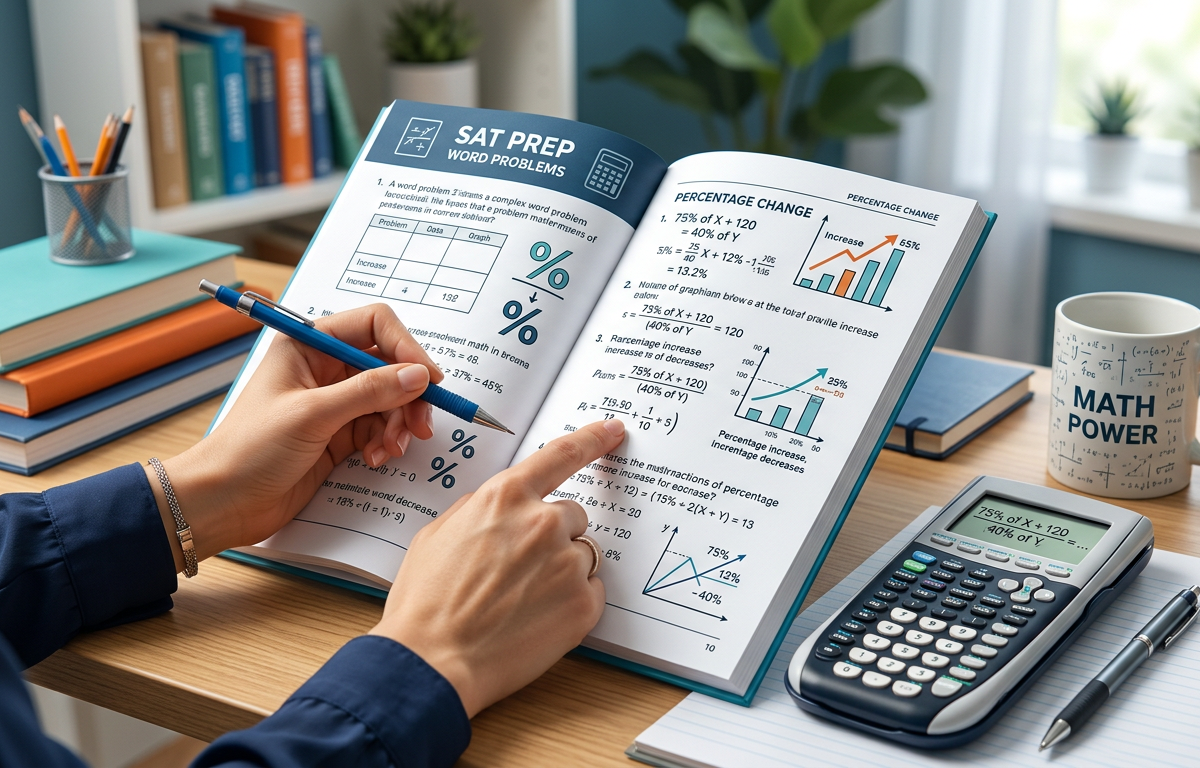
Hard SAT Percentage Word Practice Questions
Mastering Hard SAT Percentage Word Practice Questions is essential for students aiming for a top-tier score on the Digital SAT Math section. These problems frequently combine percentages with algebraic modeling, multi-step growth patterns, and compound interest concepts. By understanding how to translate complex English descriptions into precise mathematical equations, you can navigate the trickiest questions the College Board presents.
Concept Explanation
Hard SAT percentage word problems are mathematical challenges that require students to calculate changes in values, often involving multiple successive increases or decreases, relative to an unknown or shifting base. On the SAT, these questions rarely ask for a simple percentage of a number; instead, they focus on "percent change," "percent of a percent," and "exponential growth/decay." The core formula for any percentage change is:
Success on these problems depends on three critical skills:
- Translating Words to Multipliers: A 20% increase is a multiplier of , while a 20% decrease is a multiplier of .
- Handling Successive Changes: If a price increases by 10% and then decreases by 10%, the final value is of the original, not the original value itself.
- Variable Isolation: Many hard SAT math practice questions require you to solve for the original value given the final value, necessitating the use of inverse operations.
According to Khan Academy's SAT prep resources, percentages are a subset of "Problem Solving and Data Analysis," making up a significant portion of the exam. For more advanced algebraic manipulation, you might also want to review hard SAT algebra practice questions to ensure your equation-solving skills are sharp.
Solved Examples
Example 1: Successive Percent Changes
A tech company's stock price increased by 25% in January and then decreased by 20% in February. If the stock ended February at $120, what was the price at the beginning of January?
- Identify the multipliers: A 25% increase is . A 20% decrease is .
- Set up the equation: Let be the initial price.
- Simplify the product: .
- Solve for : , so . The price remained the same because the increase and decrease perfectly offset each other.
Example 2: Percent of a Remainder
A library has a collection of books. 40% of the books are fiction. Of the remaining books, 30% are biographies, and the rest are science textbooks. If there are 84 science textbooks, how many total books are in the library?
- Let be the total number of books.
- Calculate the remainder after fiction: If 40% are fiction, 60% are "remaining." Remainder = .
- Calculate science textbooks: If 30% of the remainder are biographies, then 70% of the remainder must be science textbooks.
- Set up the equation:
- Solve: . Divide both sides by . .
Example 3: Exponential Growth Modeling
The population of a town increases by 5% every 3 years. If the current population is , which expression represents the population after years?
- Determine the growth factor: .
- Determine the frequency: The growth happens every 3 years. This means the exponent should be .
- Construct the formula:
Practice Questions
1. A retailer buys a jacket for a wholesale price and marks it up by 60% to set the retail price. During a holiday sale, the retail price is reduced by 25%. If the sale price of the jacket is $144, what was the original wholesale price?
2. In a specific forest, the population of deer increased by 15% from 2010 to 2015 and then decreased by 10% from 2015 to 2020. If the population in 2020 was 4,140, what was the population in 2010?
3. A solution is 20% salt by mass. If 50 grams of pure water are added to 200 grams of this solution, what is the salt concentration of the new solution by mass?
4. The value of a certain car depreciates by % each year. After 2 years, the car is worth 64% of its original value. What is the value of ?
5. An investor's portfolio consists of stocks and bonds. Initially, 70% of the portfolio value is in stocks. After the stocks increase in value by 20% and the bonds decrease in value by 10%, what percentage of the portfolio's new total value is in stocks? (Round to the nearest tenth of a percent).
6. A rectangle's length is increased by 30% and its width is decreased by %. If the area of the rectangle remains unchanged, what is the value of ?
7. A bank account earns 4% interest compounded annually. If an initial deposit of $5,000 is made and no other deposits or withdrawals are made, which of the following represents the total interest earned after 5 years?
8. A group of students took a test. 60% of the students passed on their first attempt. Of those who did not pass, 50% passed on their second attempt. What percentage of the total group of students has not passed the test after two attempts?
9. A store manager decreases the price of an item by 20%. To return the item to its original price, by what percentage must the sale price be increased?
10. The number of bacteria in a culture doubles every 4 hours. If the culture starts with bacteria, what is the percentage increase in the number of bacteria after 12 hours?
Answers & Explanations
1. Answer: $120
Let be the wholesale price. The retail price is . The sale price is . Set this equal to 144: . Dividing by 1.20 gives . For more practice with these types of linear relationships, check out medium SAT math practice questions.
2. Answer: 4,000
Let be the 2010 population. . Multiplying the factors gives . Dividing 4,140 by 1.035 results in .
3. Answer: 16%
In the original 200g solution, the mass of salt is grams. After adding 50g of water, the new total mass is grams. The salt concentration is , or 16%.
4. Answer: 20
Let be the original value. The depreciation formula is . Cancel and take the square root of both sides: . Thus, , meaning .
5. Answer: 82.4%
Assume the initial value is $100. Stocks = $70, Bonds = $30. New stock value = . New bond value = . Total new value = . Percentage in stocks = .
6. Answer: 23.1 (or )
Area . New Area . Since the area is unchanged, . Solve for . Then , so .
7. Answer:
The total amount in the account is . The interest earned is the final amount minus the original principal.
8. Answer: 20%
If 60% passed, 40% failed. Of that 40%, half passed on the second try (). Total passed = . Therefore, 20% have still not passed.
9. Answer: 25%
If the price was $100, the sale price is $80. To return to $100, the price must increase by $20. The percentage increase is , or 25%.
10. Answer: 700%
In 12 hours, the culture doubles 3 times (). The population becomes . The increase is . As a percentage of the original , the increase is .
1. If a quantity increases by 25% and then decreases by 20%, what is the net percentage change?
Frequently Asked Questions
How do I calculate a percentage increase on the SAT?
To calculate a percentage increase, add the percentage (as a decimal) to 1 and multiply that sum by the original value. For example, to increase a value by 15%, multiply the original amount by 1.15.
What is the difference between simple and compound interest for SAT word problems?
Simple interest is calculated only on the principal amount, while compound interest is calculated on the principal plus any accumulated interest from previous periods. On the SAT, compound interest word problems usually follow the exponential growth formula .
Why don't successive 10% increases equal a 20% increase?
Successive increases do not add up because the second increase is applied to a new, larger base value rather than the original amount. For example, two 10% increases result in a total increase of 21% because .
How do I handle "percent of a remainder" questions?
You must calculate the remaining amount after the first percentage is applied before applying the second percentage. This often involves multiplying the original total by the complements of the percentages given (e.g., if 30% is removed, multiply by 0.70).
What is the fastest way to solve percentage change problems on the Digital SAT?
The fastest method is using decimal multipliers and the built-in Desmos calculator to perform quick multiplications. Converting all percentages to decimals immediately prevents common errors with fractions and long division.
Enjoyed this article?
Share it with others who might find it helpful.
Related Articles

Medium SAT Percentage Word Practice Questions
Medium SAT Percentage Word Practice Questions
Apr 26, 2026

Easy SAT Percentage Word Practice Questions
Easy SAT Percentage Word Practice Questions
Apr 26, 2026

SAT Percentage Word Practice Questions with Answers
SAT Percentage Word Practice Questions with Answers
Apr 26, 2026

Hard SAT Geometry Word Practice Questions
Hard SAT Geometry Word Practice Questions
Apr 27, 2026

Medium SAT Geometry Word Practice Questions
Medium SAT Geometry Word Practice Questions
Apr 27, 2026

Easy SAT Geometry Word Practice Questions
Easy SAT Geometry Word Practice Questions
Apr 27, 2026

Solving SAT Geometry Word Problems: Turning Text into Diagrams
SAT Geometry Word Practice Questions with Answers
Apr 27, 2026
Hard SAT Word Problems Practice Questions
Hard SAT Word Problems Practice Questions
Apr 26, 2026