Hard Punnett Square Problems Practice Questions
1. Concept Explanation
Hard Punnett square problems involve complex genetic scenarios such as dihybrid crosses, sex-linked inheritance, incomplete dominance, codominance, and polygenic traits to predict the probability of offspring genotypes and phenotypes. While a basic monohybrid cross tracks a single trait, advanced problems require an understanding of Mendelian principles like the Law of Independent Assortment, which states that alleles for different traits segregate independently during gamete formation. In these hard Punnett square problems, you must often account for multiple alleles or linked genes that do not follow simple dominant/recessive patterns. For instance, in a dihybrid cross (AaBb x AaBb), the resulting 16-square grid typically yields a 9:3:3:1 phenotypic ratio, provided the genes are on separate chromosomes. Mastering these requires careful gamete determination using the FOIL (First, Outside, Inside, Last) method and a firm grasp of inheritance questions and their underlying mechanisms.
2. Solved Examples
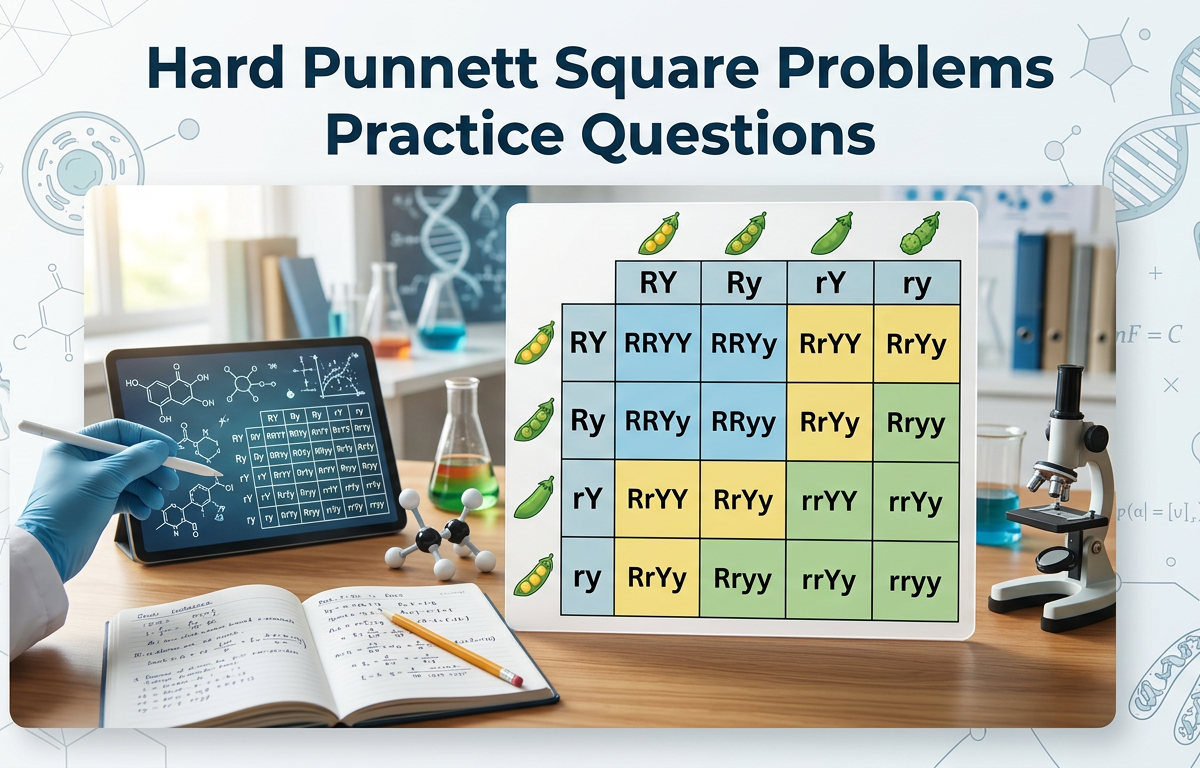
- Dihybrid Cross: In pea plants, round seeds (R) are dominant to wrinkled (r), and yellow seeds (Y) are dominant to green (y). Cross two plants that are heterozygous for both traits (RrYy x RrYy).
- Determine the gametes for each parent: RY, Ry, rY, ry.
- Set up a 4x4 Punnett square.
- Fill in the squares: The result includes genotypes like RRYY, RrYy, and rryy.
- Calculate the phenotypic ratio: 9 Round/Yellow : 3 Round/Green : 3 Wrinkled/Yellow : 1 Wrinkled/Green.
- X-Linked Recessive: Hemophilia is an X-linked recessive disorder. A carrier female (XHXh) has children with a healthy male (XHY). What is the probability of having a son with hemophilia?
- Identify parent genotypes: Female = XHXh, Male = XHY.
- Set up the square: Gametes are XH, Xh (female) and XH, Y (male).
- Analyze offspring: XHXH (healthy girl), XHXh (carrier girl), XHY (healthy boy), XhY (hemophilic boy).
- The probability of a son having the disease is 50%, but the probability of any child being a son with hemophilia is 25%.
- Incomplete Dominance: In snapdragons, flower color shows incomplete dominance. Red (RR) and white (rr) produce pink (Rr). Cross two pink flowers.
- Parent genotypes: Rr x Rr.
- Set up a 2x2 square: Gametes R and r.
- Fill the square: RR, Rr, Rr, rr.
- The phenotypic ratio is 1 Red : 2 Pink : 1 White.
3. Practice Questions
1. In humans, brown eyes (B) are dominant to blue (b), and right-handedness (R) is dominant to left-handedness (r). A brown-eyed, right-handed man (heterozygous for both) marries a blue-eyed, left-handed woman. What is the probability of them having a blue-eyed, right-handed child?
2. Color blindness is an X-linked recessive trait. A color-blind man marries a woman with normal vision whose father was color-blind. What percentage of their daughters are expected to be color-blind?
3. In a specific breed of cattle, coat color is codominant. Red (R) and white (W) produce roan (RW), which has both red and white hairs. If a roan bull is mated with a white cow, what are the expected phenotypic percentages of the offspring?
4. A man with Type AB blood marries a woman with Type O blood. They have a child. What are the possible blood types for the child, and what is the probability for each?
5. In fruit flies, gray body (G) is dominant to black body (g), and normal wings (N) are dominant to vestigial wings (n). A fly heterozygous for both traits is crossed with a black-bodied, vestigial-winged fly. What is the expected phenotypic ratio?
6. In certain plants, tall (T) is dominant to short (t) and purple flowers (P) are dominant to white (p). A plant with genotype TtPp is self-pollinated. What fraction of the offspring will be short with purple flowers?
7. A woman who is a carrier for Duchenne Muscular Dystrophy (X-linked recessive) and has Type A blood (heterozygous IAi) has a child with a man who does not have the disease and has Type O blood. What is the probability of having a son with the disease and Type O blood?
8. In a dihybrid cross involving two traits that follow incomplete dominance (e.g., flower color and leaf shape), how many different phenotypes are possible in the F2 generation if you cross two double heterozygotes?
9. A breeder crosses a black guinea pig with an albino guinea pig. All 12 offspring are black. When two of these F1 black guinea pigs are crossed, the F2 generation consists of 9 black, 3 white, and 4 albino guinea pigs. This is an example of epistasis. What was the genotype of the F1 generation?
10. If three genes (A, B, and C) assort independently, what is the probability that an offspring from the cross AaBbCc x AaBbCc will show the dominant phenotype for all three traits?
4. Answers & Explanations
- Answer: 25%. The man is BbRr and the woman is bbrr. The man's gametes are BR, Br, bR, br. The woman's gametes are all br. The offspring genotypes are BbRr, Bbrr, bbRr, bbrr. Blue-eyed, right-handed is bbRr, which is 1 out of 4.
- Answer: 50%. The man is XbY. The woman is XBXb (since her father was color-blind, she must have inherited his Xb). Their daughters will receive Xb from the father and either XB or Xb from the mother. Offspring: XBXb (carrier) and XbXb (color-blind). Half of the daughters are color-blind.
- Answer: 50% Roan, 50% White. Roan (RW) x White (WW). Gametes: R, W and W, W. Offspring: RW, RW, WW, WW.
- Answer: 50% Type A, 50% Type B. Parent genotypes: IAIB x ii. Offspring: IAi and IBi.
- Answer: 1:1:1:1. This is a test cross (GgNn x ggnn). The offspring will be GgNn (Gray/Normal), Ggnn (Gray/Vestigial), ggNn (Black/Normal), and ggnn (Black/Vestigial) in equal proportions.
- Answer: 3/16. In a TtPp x TtPp cross, the probability of short (tt) is 1/4 and the probability of purple (PP or Pp) is 3/4. Multiplying them: 1/4 * 3/4 = 3/16.
- Answer: 1/8 (12.5%). Disease probability: 1/4 (probability of being a son with the disease). Blood type probability: 1/2 (IAi x ii results in 50% ii). 1/4 * 1/2 = 1/8.
- Answer: 9. In incomplete dominance, each genotype has a unique phenotype. For two traits, there are 3 phenotypes per trait (3 x 3 = 9).
- Answer: BbCc. This 9:3:4 ratio is characteristic of recessive epistasis, where one gene (cc) masks the expression of another (B). The F1 must be dihybrid to produce this ratio.
- Answer: 27/64. For each gene, the probability of the dominant phenotype (AA or Aa) is 3/4. Since they assort independently, 3/4 * 3/4 * 3/4 = 27/64.
1. Which phenotypic ratio is expected from a dihybrid cross of two individuals heterozygous for both traits?
6. Frequently Asked Questions
What makes a Punnett square problem "hard"?
Hard problems usually involve tracking two or more traits simultaneously (dihybrid or trihybrid crosses) or incorporate non-Mendelian patterns like linkage, epistasis, and sex-linked traits. They require a deeper understanding of DNA replication and chromosomal behavior during meiosis.
How do you find gametes for a dihybrid cross?
You use the FOIL method (First, Outside, Inside, Last) on the parental genotype. For a parent with genotype AaBb, the gametes are AB, Ab, aB, and ab, representing all possible combinations of one allele from each gene.
What is the difference between incomplete dominance and codominance?
Incomplete dominance results in a blended phenotype, such as red and white flowers producing pink, whereas codominance results in both traits being expressed simultaneously, like a cow with both red and white hairs. Both deviate from standard Mendelian dominance where one allele hides the other.
Why are males more affected by X-linked disorders?
Males are hemizygous, meaning they have only one X chromosome inherited from their mother. If that X chromosome carries a recessive mutation, there is no second X chromosome to provide a dominant functional allele to mask it, as explained in Punnett square problems involving sex chromosomes.
Can a Punnett square predict the exact number of offspring?
No, a Punnett square only predicts the probability or likelihood of specific genotypes and phenotypes occurring in each offspring. Actual results in small sample sizes may deviate from these theoretical ratios due to random chance in fertilization.
Enjoyed this article?
Share it with others who might find it helpful.
Related Articles
Hard Le Chatelier’s Principle Practice Questions
Master Hard Le Chatelier’s Principle Practice Questions with our comprehensive guide featuring solved examples, practice problems, and detailed explanations.
Mar 30, 2026

Hard Reaction Quotient (Q) Practice Questions
Hard Reaction Quotient (Q) Practice Questions
Mar 30, 2026

Grams to Moles Practice Questions with Answers
Master grams to moles conversions with our comprehensive guide. Includes step-by-step examples, practice questions, and detailed answers for chemistry students.
Mar 26, 2026
Avogadro’s Number Practice Questions with Answers
Master the mole concept with our Avogadro’s Number practice questions. Includes step-by-step solved examples, a quick quiz, and detailed explanations.
Mar 26, 2026

Empirical Formulas: Solving Ratios from Mass and Percent Data
Master empirical formula calculations with 10 practice questions, worked answers, and a free step-by-step calculator for mass, percentage, and combustion problems.
Mar 26, 2026