Hard MCAT Optics Practice Questions
Hard MCAT Optics Practice Questions
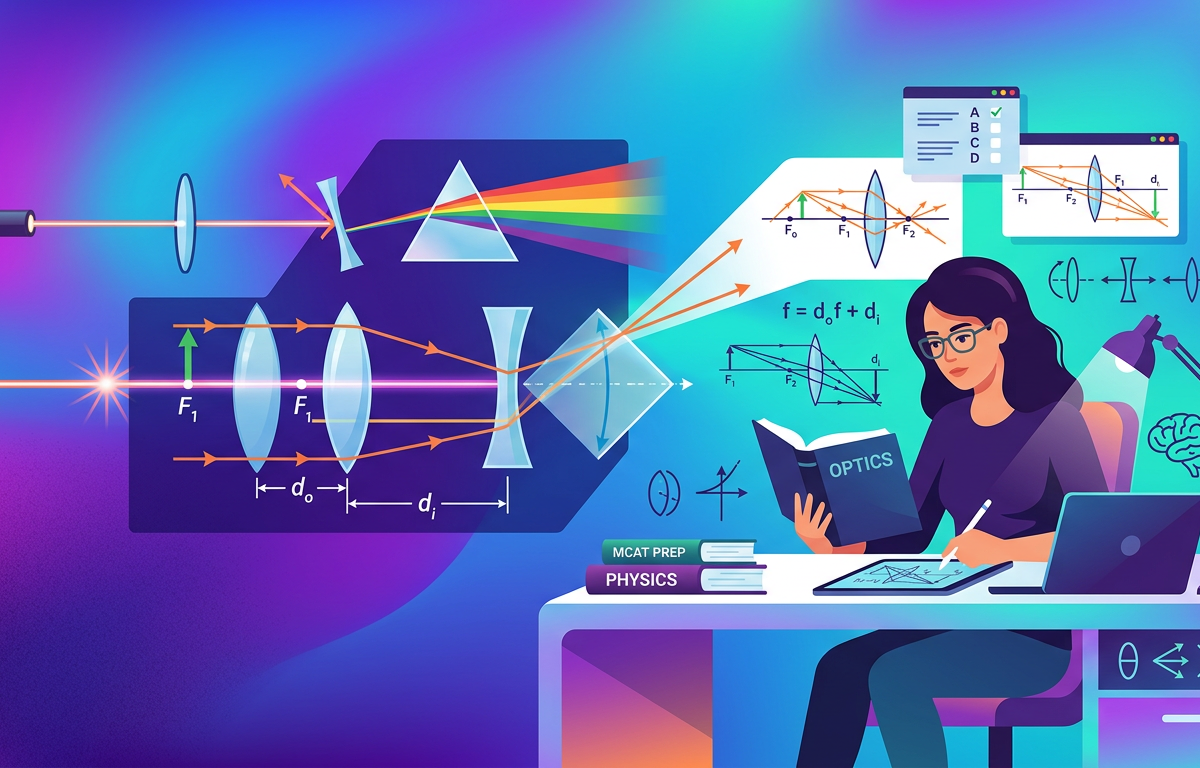
Mastering optics is essential for a high score on the Chemical and Physical Foundations of Biological Systems section. These Hard MCAT Optics Practice Questions will challenge your understanding of light behavior, lens systems, and the mathematical relationships that govern image formation. Unlike basic physics problems, MCAT-style optics questions often combine multiple concepts—such as refraction, magnification, and power—into complex scenarios involving the human eye or advanced laboratory equipment.
Concept Explanation
Optics is the branch of physics that studies the behavior and properties of light, including its interactions with matter and the instruments used to detect it. For the MCAT, you must be proficient in geometric optics, which treats light as rays traveling in straight lines. The two primary phenomena are reflection, where light bounces off a surface, and refraction, where light bends as it passes from one medium to another. Refraction is governed by Snell's Law, expressed as:
Key variables include the index of refraction , which is the ratio of the speed of light in a vacuum to the speed in the medium (). When dealing with lenses and mirrors, the thin lens equation is your most powerful tool:
Where is the focal length, is the object distance, and is the image distance. Understanding sign conventions is critical: for a single lens, a positive indicates a real image on the opposite side of the lens, while a negative indicates a virtual image on the same side as the object. Furthermore, magnification is calculated as . If you are looking for more practice with quantitative chemistry to balance your physics prep, check out our Hard MCAT Stoichiometry Practice Questions.
Solved Examples
Example 1: Multiple Lens Systems
An object is placed 20 cm in front of a converging lens with a focal length of 10 cm. A second converging lens with a focal length of 5 cm is placed 25 cm behind the first lens. Find the final image position.
- Calculate the image from the first lens: . Thus, .
- The image from lens 1 acts as the object for lens 2. Since lens 2 is 25 cm from lens 1, and the image is 20 cm from lens 1, the new object distance is .
- Calculate the final image: . This means is at infinity (parallel rays).
Example 2: The Human Eye and Power
A farsighted individual has a near point of 100 cm. What power lens (in Diopters) is needed to bring the near point to 25 cm?
- The goal is to take an object at 25 cm () and create a virtual image at the person's actual near point (). Note the negative sign for a virtual image.
- Use the power formula .
- Substitute the values: .
Example 3: Index of Refraction and Wavelength
Light with a wavelength of 600 nm in a vacuum enters a diamond (). What is the wavelength and speed of the light inside the diamond?
- Calculate speed: .
- Calculate wavelength: .
- The frequency remains constant regardless of the medium change.
Practice Questions
1. A diverging lens with a focal length of -15 cm is placed 30 cm from an object. What are the characteristics of the image formed?
2. A ray of light travels from air () into an unknown liquid at an incident angle of 45°. The refracted angle is 30°. What is the index of refraction of the liquid?
3. An object is placed at the center of curvature of a concave mirror with a focal length of 20 cm. Where is the image located, and what is its magnification?
Track your MCAT progress intelligently.
Use Bevinzey’s analytics and AI-powered feedback to identify weaknesses and improve faster.
See My Progress4. A compound microscope uses an objective lens with and an eyepiece with . If the object is 1.1 cm from the objective, find the overall magnification if the final image is viewed at infinity.
5. Calculate the critical angle for total internal reflection for a light ray moving from glass () to water ().
6. A converging lens has a focal length of 12 cm. At what two object distances will the image be three times the size of the object?
7. If the intensity of a light beam is reduced by 75% after passing through a polarizing filter, what was the angle between the light's initial polarization and the filter's axis? (Assume initial light was already polarized).
8. A convex mirror has a radius of curvature of 40 cm. An object is placed 10 cm from the mirror. Determine the image distance and magnification.
9. Chromatic aberration occurs because the index of refraction of glass depends on wavelength. If blue light has a higher index of refraction than red light, which color will have a shorter focal length in a biconvex lens?
10. A laser emits light with a frequency of . When this light enters a medium with , what is the new frequency?
Answers & Explanations
1. Answer: Virtual, upright, and reduced (, ).
Using the lens equation: . Solving for gives . Thus, . Magnification . Diverging lenses always produce virtual, upright, and reduced images for real objects.
2. Answer: .
Using Snell's Law: . Since and , we have . Dividing by 0.5 gives .
3. Answer: 40 cm in front of the mirror; .
The center of curvature . Using the mirror equation: . . Thus, . Magnification . The image is real, inverted, and the same size.
4. Answer: -50.
First, find the image from the objective: . , so . Magnification of objective . For the eyepiece viewed at infinity, angular magnification is . Total magnification .
5. Answer: 62.5°.
Total internal reflection occurs when the refracted angle is 90°. . . . .
6. Answer: 16 cm (real image) and 8 cm (virtual image).
Case 1 (Real, inverted): , so . . . Case 2 (Virtual, upright): , so . . .
7. Answer: 60°.
Malus's Law states . If intensity is reduced by 75%, it is 25% of the original: . . .
8. Answer: , .
For a convex mirror, (focal length is negative). . . . . If you struggle with these sign conventions, reviewing Medium MCAT General Chemistry Practice Questions can help solidify your problem-solving logic.
9. Answer: Blue light.
By the Lens Maker's Equation, power is proportional to . A higher index of refraction (blue light) results in a higher power, which means a shorter focal length. This is why blue light bends more than red light.
10. Answer: .
The frequency of a wave is determined by the source and does not change when moving between media. Only wavelength and velocity change proportionally to maintain .
1. Which of the following describes the image formed by a single converging lens when the object is placed at a distance exactly equal to the focal length?
Frequently Asked Questions
What is the difference between a real and virtual image on the MCAT?
A real image is formed by the actual convergence of light rays and can be projected onto a screen, whereas a virtual image is formed by rays that only appear to diverge from a point. On the MCAT, real images are always inverted and virtual images are always upright for single-lens systems.
How do you determine the sign of focal length for mirrors and lenses?
The focal length is positive for converging systems (concave mirrors and convex lenses) and negative for diverging systems (convex mirrors and concave lenses). Remembering this "positive-converging" rule is essential for solving calculation-heavy optics problems quickly.
What is the relationship between power and focal length?
Power is the reciprocal of the focal length, expressed as , where the focal length must be in meters to obtain the unit of Diopters. A lens with a short focal length has high optical power because it bends light more aggressively than a lens with a long focal length.
Why does the frequency of light remain constant during refraction?
Frequency is a property of the wave source and the energy of the photons, which must be conserved as the wave crosses a boundary between different media. While the speed and wavelength change to accommodate the new medium's index of refraction, the number of wave cycles passing a point per second remains the same.
What is spherical aberration in optical systems?
Spherical aberration occurs when light rays striking the outer edges of a spherical lens or mirror focus at a slightly different point than rays striking near the center. This results in a blurred image and is typically corrected by using parabolic surfaces or specialized lens coatings.
How does the MCAT test the concept of dispersion?
The MCAT tests dispersion by asking how different colors of light bend when passing through a prism, where higher frequency light (violet/blue) refracts more than lower frequency light (red). This occurs because the index of refraction of a material is slightly higher for shorter wavelengths.
Track your MCAT progress intelligently.
Use Bevinzey’s analytics and AI-powered feedback to identify weaknesses and improve faster.
See My ProgressReviewed by
Michael Danquah, MS, PhD
Dr. Michael Danquah is a professor of pharmaceutical sciences and founder of several educational technology platforms focused on improving student learning and performance.
Enjoyed this article?
Share it with others who might find it helpful.
Related Articles
Medium MCAT Optics Practice Questions
Medium MCAT Optics Practice Questions
May 17, 2026
Easy MCAT Optics Practice Questions
Easy MCAT Optics Practice Questions
May 17, 2026

Hard MCAT Thermodynamics Practice Questions
Hard MCAT Thermodynamics Practice Questions
May 17, 2026
Hard MCAT Kinematics Practice Questions
Hard MCAT Kinematics Practice Questions
May 17, 2026
Medium MCAT Thermodynamics Practice Questions
Master thermodynamics with medium-level MCAT practice questions covering Gibbs Free Energy, enthalpy, entropy, and the laws of thermodynamics with full explanations.
May 17, 2026

Medium MCAT Circuits Practice Questions
Medium MCAT Circuits Practice Questions
May 17, 2026
Medium MCAT Kinematics Practice Questions
Medium MCAT Kinematics Practice Questions
May 17, 2026
Medium MCAT Physics Practice Questions
Master medium-level MCAT physics with our comprehensive guide featuring solved examples, practice questions, and detailed explanations of core concepts.
May 17, 2026