Hard Genetics Practice Questions Practice Questions
Concept Explanation
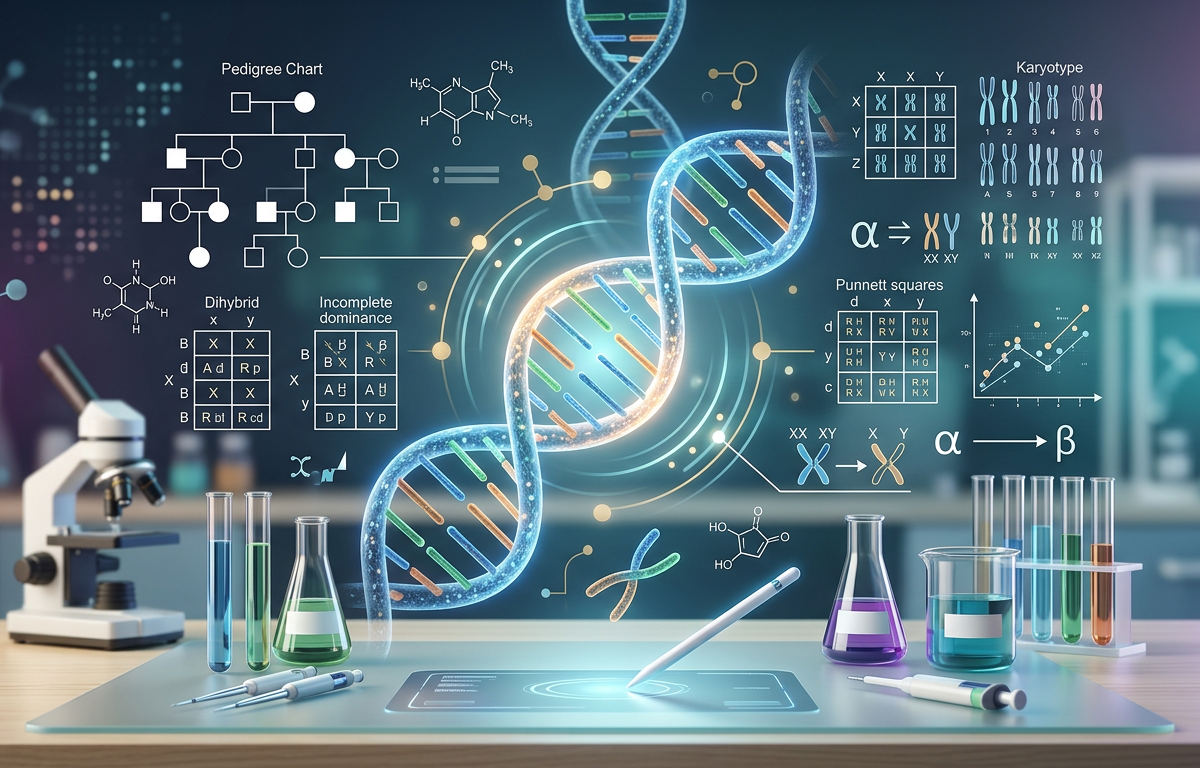
Hard Genetics Practice Questions involve the quantitative analysis of complex inheritance patterns such as gene linkage, epistasis, polygenic inheritance, and non-Mendelian pedigree analysis. These advanced problems require an understanding of how genes interact on the same chromosome and how the environment or other gene loci can modify phenotypic ratios. For example, while standard Mendelian genetics predicts a 9:3:3:1 ratio in a dihybrid cross, gene linkage significantly alters these proportions because alleles do not assort independently. Mastery of these concepts is essential for students preparing for advanced placement exams or undergraduate biological sciences. Understanding these mechanisms often requires a strong foundation in inheritance questions and the molecular basis of heredity.
Advanced genetics also explores the concept of recombination frequency. This is a measure of genetic linkage and is used in the creation of genetic linkage maps. The distance between two genes on a chromosome is measured in centimorgans (cM), where 1 cM represents a 1% chance that two markers will be separated by a recombination event during meiosis. High-level problems frequently ask students to calculate these distances based on offspring phenotypes or to predict the probability of specific genotypes in pedigrees involving X-linked recessive disorders or mitochondrial inheritance.
Solved Examples
- Gene Linkage and Recombination: In fruit flies (Drosophila), the gene for body color (B = gray, b = black) and wing shape (V = normal, v = vestigial) are linked. A heterozygous gray, normal-winged fly (BbVv) is crossed with a black, vestigial-winged fly (bbvv). The offspring are: 415 gray/normal, 92 gray/vestigial, 88 black/normal, and 405 black/vestigial. Calculate the recombination frequency.
- Identify parental types: gray/normal (415) and black/vestigial (405).
- Identify recombinant types: gray/vestigial (92) and black/normal (88).
- Sum the recombinants: 92 + 88 = 180.
- Calculate the total offspring: 415 + 92 + 88 + 405 = 1000.
- Apply the formula: (Recombinants / Total) × 100 = (180 / 1000) × 100 = 18%.
- Epistasis: In a specific breed of dogs, coat color is determined by two genes. Gene B determines color intensity (B = Black, b = brown), while Gene E determines if the pigment is deposited in the hair (E = deposited, e = not deposited/yellow). If two black dogs (BbEe) are crossed, what is the probability of obtaining a yellow puppy?
- Recognize this as recessive epistasis. The presence of 'ee' masks the expression of Gene B.
- Set up a 4x4 Punnett square or use probability rules.
- The genotypes resulting in yellow are __ee (BBee, Bbee, or bbee).
- In a dihybrid cross, the ratio of __ee is 4/16 (or 1/4).
- Therefore, there is a 25% probability of a yellow puppy.
- X-Linked Pedigree Probability: A woman whose father had hemophilia (an X-linked recessive disorder) marries a man with normal blood clotting. What is the probability that their first son will have hemophilia?
- Determine the woman's genotype: Since her father was XhY, she must be a carrier (XHXh).
- Determine the man's genotype: He is XHY.
- Analyze the male offspring possibilities: The son receives the Y from the father and either XH or Xh from the mother.
- Probability of the son receiving Xh is 1/2.
- The probability that their first son has hemophilia is 50%.
Practice Questions
1. In a plant species, flower color is controlled by two genes (A and B) that exhibit duplicate dominant epistasis. If either dominant allele A or B is present, the flower is purple. Only the aabb genotype produces white flowers. If two AaBb plants are crossed, what is the expected phenotypic ratio of purple to white flowers?
2. Three genes (X, Y, and Z) are located on the same chromosome. The recombination frequency between X and Y is 12%, between Y and Z is 8%, and between X and Z is 4%. Determine the correct linear order of these genes on the chromosome.
3. A researcher performs a testcross with a trihybrid organism (AaBbCc) and observes that the most frequent offspring classes are ABC and abc, while the least frequent are AbC and aBc. Which gene is located in the middle?
4. In humans, the ABO blood group is determined by multiple alleles (IA, IB, i). A woman with type A blood (whose father was type O) marries a man with type AB blood. What is the probability that they will have a child with type B blood?
5. Color blindness is an X-linked recessive trait. A woman with normal vision, whose father was color-blind, has a child with a man who has normal vision. What is the probability that a daughter born to this couple will be a carrier?
6. In a population of 1000 individuals, 160 show a recessive phenotype. Assuming Hardy-Weinberg equilibrium, calculate the frequency of the dominant allele (p) and the number of heterozygous individuals.
7. Two linked genes, P and Q, are 20 m.u. (map units) apart. A dihybrid individual (PQ/pq) is crossed with a double recessive individual (pq/pq). What percentage of the offspring will be Pq/pq?
8. A certain type of deafness is caused by recessive mutations in two different genes (d or e). Both dominant alleles (D and E) are required for normal hearing. If a Ddee individual mates with a ddEe individual, what fraction of their offspring will be deaf?
9. Red-green color blindness is X-linked. If a female carrier for color blindness has children with a color-blind male, what percentage of their total offspring are expected to be color-blind females?
10. In a mapping experiment, the recombination frequency between Gene A and Gene B is 15%, and between Gene B and Gene C is 25%. If the recombination frequency between A and C is 40%, what is the sequence of the genes?
Answers & Explanations
- 15:1. In duplicate dominant epistasis, any dominant allele results in the purple phenotype. The only white phenotype is aabb. In a dihybrid cross (AaBb x AaBb), the ratio is 9 (A_B_) : 3 (A_bb) : 3 (aaB_) : 1 (aabb). Adding all classes with at least one dominant allele (9+3+3) gives 15 purple and 1 white.
- X - Z - Y. The largest distance is between X and Y (12%), meaning they are the flanking genes. Since X to Z is 4% and Z to Y is 8% (4 + 8 = 12), Z must be in the middle.
- Gene B. The least frequent classes result from double crossovers. Comparing the parental (ABC/abc) with the double recombinants (AbC/aBc), we see that the B/b alleles have swapped relative to A and C. This indicates B is the central gene.
- 25%. The woman is IAi (since her father was ii). The man is IAIB. Cross: IAi x IAIB. Possible genotypes: IAIA (Type A), IAIB (Type AB), IAi (Type A), and IBi (Type B). Only 1 out of 4 is Type B.
- 50%. The mother is XCXc and the father is XCY. Daughters receive XC from the father. From the mother, they have a 50% chance of receiving XC (Normal) and a 50% chance of receiving Xc (Carrier).
- p = 0.6; 480 heterozygotes. q² = 160/1000 = 0.16. Therefore, q = 0.4. Since p + q = 1, p = 0.6. Heterozygotes (2pq) = 2(0.6)(0.4) = 0.48. 0.48 * 1000 = 480.
- 10%. The distance of 20 m.u. means the total recombination frequency is 20%. There are two recombinant types (Pq and pQ), so each represents 10% of the total offspring.
- 3/4. Genotypes: DdEe (hearing), Ddee (deaf), ddEe (deaf), ddee (deaf). Only DdEe has at least one of each dominant allele. 3 out of 4 genotypes lack one or both, resulting in deafness.
- 25%. Mother is XCXc, Father is XcY. Possible offspring: XCXc (carrier girl), XcXc (color-blind girl), XCY (normal boy), XcY (color-blind boy). Color-blind females (XcXc) are 1 out of 4.
- A - B - C. Since the distance A-C (40%) is the sum of A-B (15%) and B-C (25%), B must be located between A and C.
1. Which term describes a scenario where one gene masks the phenotypic expression of another gene at a different locus?
Frequently Asked Questions
What is the difference between linked and unlinked genes?
Linked genes are located close together on the same chromosome and tend to be inherited together, whereas unlinked genes are either on different chromosomes or far apart on the same chromosome, allowing them to assort independently during meiosis. You can practice identifying these patterns using Punnett square problems.
How do you calculate recombination frequency?
To calculate recombination frequency, divide the total number of recombinant offspring by the total number of offspring produced and multiply by 100. This value represents the genetic distance between two loci in centimorgans.
What is the purpose of a testcross in genetics?
A testcross involves breeding an individual of unknown genotype with a homozygous recessive individual to determine the unknown genotype based on the phenotypic ratios of the offspring. This technique is fundamental for identifying heterozygosity in organisms.
Can recombination frequency ever exceed 50%?
No, the maximum recombination frequency is 50%, which indicates that genes are so far apart on a chromosome (or on separate chromosomes) that they assort independently, behaving as if they are unlinked. For more on the basics of cellular division and DNA, see our guide on DNA replication questions.
What are double crossovers?
Double crossovers occur when two separate exchange events happen between two specific gene loci during meiosis, which can effectively "cancel out" the recombination for the outer genes while switching the middle gene. According to the National Human Genome Research Institute, this process is vital for increasing genetic diversity.
Enjoyed this article?
Share it with others who might find it helpful.
Related Articles

Medium Genetics Practice Questions Practice Questions
Master genetics with our medium-level practice questions covering Punnett squares, X-linked traits, and Mendelian ratios with detailed step-by-step solutions.
Apr 25, 2026
Easy Genetics Practice Questions Practice Questions
Master the basics of heredity with our Easy Genetics Practice Questions Practice Questions. Learn about alleles, genotypes, and phenotypes with solved examples.
Apr 25, 2026
Hard Microbiology Practice Questions Practice Questions
Hard Microbiology Practice Questions Practice Questions
Apr 26, 2026

Medium Microbiology Practice Questions Practice Questions
Master microbiology with our medium-level practice questions covering bacterial growth, genetics, and metabolism. Includes solved examples and a quick quiz.
Apr 26, 2026

Easy Microbiology Practice Questions Practice Questions
Easy Microbiology Practice Questions Practice Questions
Apr 26, 2026

Hard Enzyme Questions Practice Questions
Master complex biochemistry with these hard enzyme questions. Cover Michaelis-Menten kinetics, inhibition types, and Lineweaver-Burk plots with solved examples.
Apr 26, 2026

Medium Enzyme Questions Practice Questions
Master enzyme kinetics and regulation with our Medium Enzyme Questions Practice Questions. Includes solved examples, detailed explanations, and a quick quiz.
Apr 26, 2026
Enzyme Questions Practice Questions with Answers
Master enzyme kinetics and function with our comprehensive guide. Includes solved examples, practice questions, and detailed answers on biological catalysts.
Apr 26, 2026