Hard Enzyme Questions Practice Questions

Concept Explanation
Enzymes are specialized biological catalysts, primarily composed of proteins, that accelerate chemical reactions by lowering the activation energy required for a reaction to proceed. These molecules do not alter the equilibrium of a reaction; instead, they increase the rate at which equilibrium is reached by stabilizing the transition state. Understanding Hard Enzyme Questions requires a deep dive into Michaelis-Menten kinetics, where the relationship between substrate concentration and reaction rate is quantified through constants like Km (the Michaelis constant) and Vmax (the maximum velocity). Beyond simple catalysis, enzyme activity is regulated through competitive, non-competitive, and uncompetitive inhibition, as well as allosteric modulation. These concepts are foundational to understanding complex biological systems, much like how hard DNA replication questions explore the precision of molecular machinery. Enzymes operate with high specificity, often described by the "induced fit" model, where the active site undergoes conformational changes to bind the substrate more effectively.
Solved Examples
Review these worked examples to master the mathematical and conceptual logic behind advanced enzymology.
- Calculating Catalytic Efficiency: An enzyme has a Vmax of 100 µmol/min and a Km of 2 mM. If the total enzyme concentration ([Et]) is 0.1 µM, calculate the turnover number (kcat) and the catalytic efficiency.
- Convert Vmax to molar units per second: (100 x 10^-6 mol / 60 sec) = 1.67 x 10^-6 mol/sec.
- Calculate kcat using the formula Vmax = kcat[Et]: kcat = (1.67 x 10^-6 mol/sec) / (0.1 x 10^-6 mol) = 16.7 s^-1.
- Calculate catalytic efficiency (kcat/Km): 16.7 s^-1 / 0.002 M = 8350 M^-1s^-1.
- Determining Inhibition Type from Vmax and Km: In the presence of an inhibitor, the Km of an enzyme increases from 5 mM to 10 mM, while the Vmax remains constant at 50 units/min. Identify the type of inhibition.
- Observe the change in Km: It has increased, meaning the enzyme's affinity for the substrate appears lower.
- Observe the change in Vmax: It remains unchanged.
- Conclusion: Since the inhibitor can be overcome by increasing substrate concentration (keeping Vmax the same), this is competitive inhibition.
- The Lineweaver-Burk Plot: A researcher finds the y-intercept of a double-reciprocal plot is 0.02 (min/µmol) and the x-intercept is -0.5 mM^-1. Find Vmax and Km.
- Vmax = 1 / y-intercept: 1 / 0.02 = 50 µmol/min.
- Km = -1 / x-intercept: -1 / (-0.5) = 2 mM.
Practice Questions
Test your knowledge with these hard enzyme questions designed to challenge your understanding of kinetics and regulation.
- An enzyme-catalyzed reaction follows Michaelis-Menten kinetics. If the substrate concentration [S] is equal to 3 times the Km, what percentage of Vmax is the initial velocity (V0)?
- Describe the effect of an uncompetitive inhibitor on both the Vmax and the Km of an enzymatic reaction. Why do both values change in the same direction?
- A specific enzyme has a kcat of 500 s^-1. In a reaction where the total enzyme concentration is 2 nM, what is the maximum velocity (Vmax) in nM/s?
- In an allosteric enzyme system, how does the addition of a positive effector shift the sigmoidal velocity-substrate curve, and what does this indicate about the T-state to R-state transition?
- Compare and contrast the "Lock and Key" model with the "Induced Fit" hypothesis. Which model better explains the stabilization of the transition state?
- If a non-competitive inhibitor is added to a reaction, how will the Lineweaver-Burk plot change compared to the uninhibited reaction? Mention both intercepts.
- Explain how the thermodynamics of an enzyme affects the Gibbs free energy (ΔG) of a reaction. Does the enzyme change the spontaneity of the process?
- An enzyme is regulated by feedback inhibition in a metabolic pathway. If the end product of the pathway is a non-competitive inhibitor of the first enzyme, how will the Vmax of that first enzyme be affected as the end product accumulates?
- Calculate the [S] required to reach 90% of Vmax if the Km is 0.5 mM.
- Why are enzymes sensitive to changes in pH? Relate your answer to the ionization states of amino acid side chains in the active site.
Answers & Explanations
- Answer: 75% of Vmax. Using the Michaelis-Menten equation: V0 = (Vmax * [S]) / (Km + [S]). Substituting [S] = 3Km, we get V0 = (Vmax * 3Km) / (Km + 3Km) = (Vmax * 3Km) / 4Km = 3/4 Vmax, which is 75%.
- Answer: Both Vmax and Km decrease. Uncompetitive inhibitors bind only to the enzyme-substrate (ES) complex. This removes ES from the pool, shifting the equilibrium toward ES formation (decreasing Km) and reducing the effective concentration of active enzyme that can produce product (decreasing Vmax).
- Answer: 1000 nM/s. Using the formula Vmax = kcat * [Et], we calculate 500 s^-1 * 2 nM = 1000 nM/s.
- Answer: Shifts the curve to the left. A positive effector stabilizes the R-state (relaxed, high affinity), lowering the [S] required to reach half-maximal velocity and making the enzyme more active at lower substrate concentrations.
- Answer: Induced Fit. Unlike the rigid Lock and Key model, the Induced Fit model suggests the enzyme changes shape upon binding. This flexibility allows the enzyme to exert physical stress on the substrate, stabilizing the transition state and lowering activation energy.
- Answer: Y-intercept increases, X-intercept stays the same. In non-competitive inhibition, Vmax decreases (so 1/Vmax increases, moving the y-intercept up), but Km remains unchanged (so -1/Km remains the same).
- Answer: ΔG remains unchanged. Enzymes lower the activation energy (Ea) but do not change the free energy of the reactants or products. Therefore, they cannot make a non-spontaneous reaction spontaneous.
- Answer: Vmax will decrease. Accumulation of the end product (inhibitor) will bind to an allosteric site on the first enzyme, reducing its catalytic turnover regardless of how much substrate is present.
- Answer: 4.5 mM. Set V0 = 0.9 Vmax. 0.9 Vmax = (Vmax * [S]) / (Km + [S]). 0.9 = [S] / (0.5 + [S]). Solving for [S]: 0.45 + 0.9[S] = [S] → 0.45 = 0.1[S] → [S] = 4.5.
- Answer: Ionization changes. pH affects the protonation state of R-groups on amino acids. If an active site requires a deprotonated Histidine to act as a nucleophile, lowering the pH will protonate it, rendering the enzyme inactive. This is a common theme in hard cell structure practice questions regarding lysosomal function.
1. Which of the following constants represents the substrate concentration at which the reaction rate is half of Vmax?
Frequently Asked Questions
What is the difference between Km and affinity?
Km is the substrate concentration at half-maximal velocity, while affinity refers to how tightly an enzyme binds its substrate. Generally, a lower Km value indicates a higher affinity because less substrate is needed to saturate the enzyme.
How does temperature affect enzyme-catalyzed reactions?
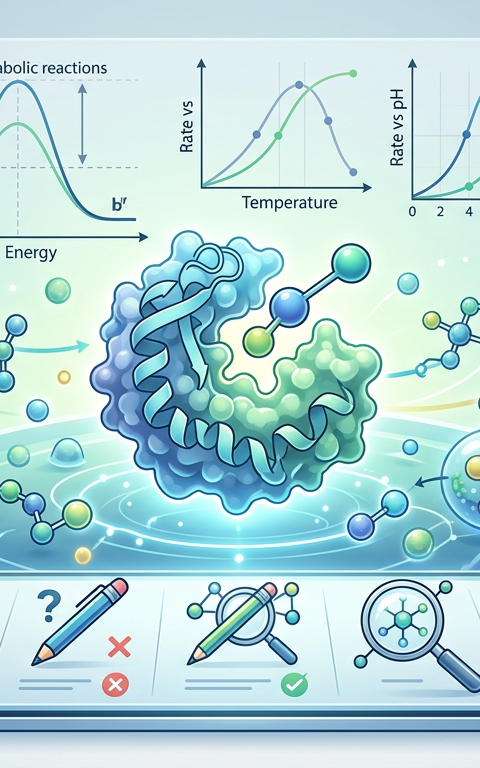
Increasing temperature initially increases the reaction rate by providing more kinetic energy for collisions. However, exceeding the optimal temperature leads to denaturation, where the enzyme's tertiary structure unfolds and activity is lost.
What is a coenzyme?
A coenzyme is a non-protein organic molecule, such as a vitamin derivative, that binds to an enzyme to assist in its catalytic function. They often act as intermediate carriers of electrons or specific functional groups during the reaction.
What occurs during non-competitive inhibition?
In non-competitive inhibition, the inhibitor binds to an allosteric site rather than the active site, changing the enzyme's shape. This reduces the Vmax because the enzyme's catalytic efficiency is impaired, but it does not change the Km because substrate binding is not directly blocked.
Why is the catalytic efficiency (kcat/Km) limited by diffusion?
The upper limit of catalytic efficiency is determined by how fast substrate molecules can diffuse through the medium to reach the enzyme's active site. This "diffusion limit" is typically between 10^8 and 10^9 M^-1s^-1, representing a "perfect" enzyme.
Enjoyed this article?
Share it with others who might find it helpful.
Related Articles

Medium Enzyme Questions Practice Questions
Master enzyme kinetics and regulation with our Medium Enzyme Questions Practice Questions. Includes solved examples, detailed explanations, and a quick quiz.
Apr 26, 2026
Enzyme Questions Practice Questions with Answers
Master enzyme kinetics and function with our comprehensive guide. Includes solved examples, practice questions, and detailed answers on biological catalysts.
Apr 26, 2026

Hard Microbiology Practice Questions Practice Questions
Hard Microbiology Practice Questions Practice Questions
Apr 26, 2026

Medium Microbiology Practice Questions Practice Questions
Master microbiology with our medium-level practice questions covering bacterial growth, genetics, and metabolism. Includes solved examples and a quick quiz.
Apr 26, 2026

Easy Microbiology Practice Questions Practice Questions
Easy Microbiology Practice Questions Practice Questions
Apr 26, 2026

Microbiology Practice Questions Practice Questions with Answers
Master microbiology with our comprehensive guide featuring concept explanations, solved examples, and practice questions with detailed answers.
Apr 26, 2026

Hard Physiology Practice Questions Practice Questions
Dive into hard physiology practice questions to master complex bodily functions, regulatory systems, and cellular mechanisms.
Apr 25, 2026

Medium Physiology Practice Questions Practice Questions
Boost your understanding of physiological processes with these medium physiology practice questions covering homeostasis, organ systems, and cellular functions.
Apr 25, 2026