Hard Cell Membrane Questions Practice Questions
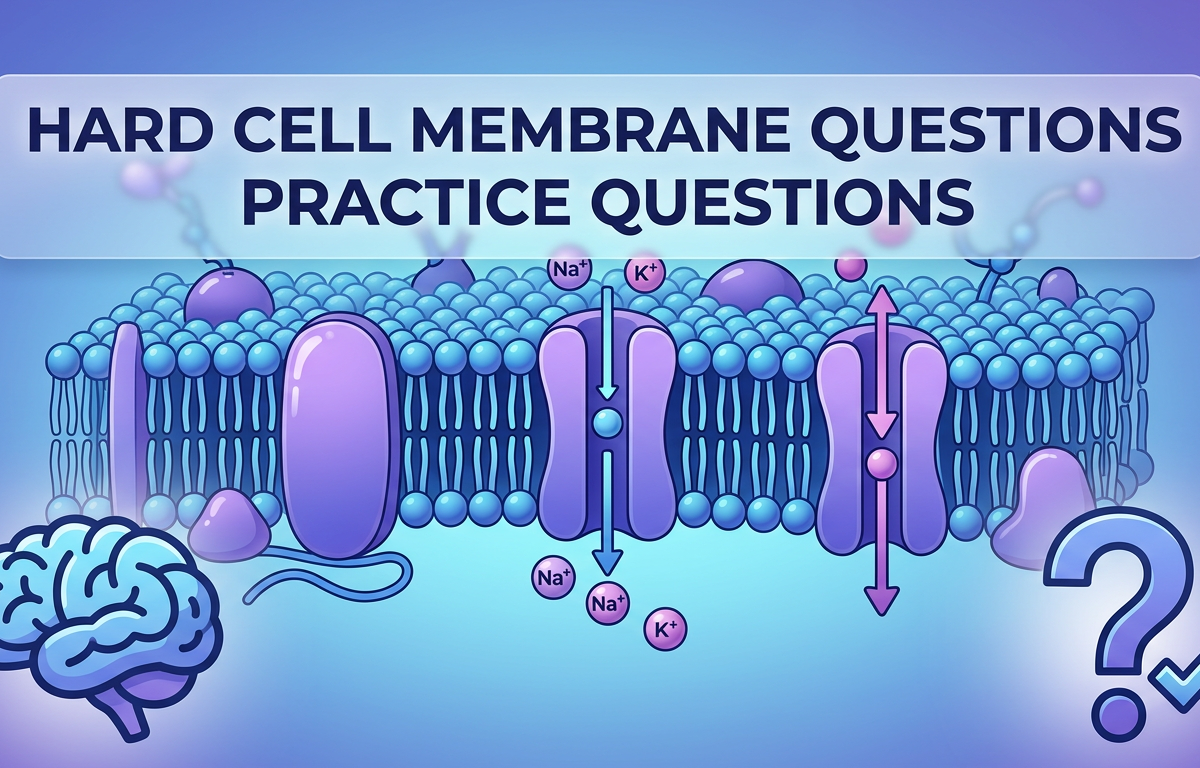
Hard Cell Membrane Questions Practice Questions
The cell membrane is far more than a simple container for the cell's contents. It is a dynamic, complex interface that governs all traffic in and out of the cell, facilitates communication, and organizes cellular processes. To truly master cell biology, you must move beyond basic definitions and tackle the intricate mechanisms at play. This guide provides a series of hard cell membrane questions designed to test your understanding of these advanced concepts, from electrochemical gradients to the biophysics of membrane fluidity.
Concept Explanation
The cell membrane is a selectively permeable barrier, composed of a phospholipid bilayer with embedded proteins, that encloses every cell and regulates the passage of substances. This structure is best described by the fluid mosaic model, which emphasizes that the membrane is not static. Its components, including lipids and proteins, can move laterally, giving it fluidity. The 'mosaic' aspect refers to the patchwork of various proteins embedded within or attached to the bilayer.
Key Advanced Concepts:
- Electrochemical Gradients: Cells maintain concentration gradients of ions (like Na+, K+, Ca2+, and Cl-) across their membranes. Because ions are charged, this separation creates both a chemical gradient (concentration difference) and an electrical gradient (voltage difference, or membrane potential). Together, these form the electrochemical gradient, which is a source of potential energy used to drive many cellular processes.
- Membrane Potential: This is the voltage difference across the plasma membrane, typically with the inside of the cell being negative relative to the outside. It is primarily established by the activity of the Na+/K+ pump (which pumps 3 Na+ out for every 2 K+ in) and the differential permeability of the membrane to ions, especially the outward leak of K+ through potassium leak channels.
- Secondary Active Transport: This transport mechanism uses the energy stored in an electrochemical gradient, typically created by a primary active transporter (like the Na+/K+ pump), to move another substance against its own concentration gradient. It does not directly consume ATP.
- Symport: The driver ion and the transported molecule move in the same direction (e.g., the sodium-glucose symporter, SGLT1).
- Antiport: The driver ion and the transported molecule move in opposite directions (e.g., the sodium-calcium exchanger).
- Membrane Fluidity: The fluidity of the membrane is crucial for its function and is influenced by several factors. Shorter fatty acid tails and more unsaturated (double-bonded) fatty acid tails increase fluidity because they pack less tightly. Cholesterol acts as a bidirectional regulator: at high temperatures, it restrains phospholipid movement, decreasing fluidity, while at low temperatures, it prevents tight packing, increasing fluidity.
- Lipid Rafts: These are specialized microdomains within the cell membrane that are enriched in cholesterol, sphingolipids, and certain proteins. They are thicker and less fluid than the surrounding membrane. Lipid rafts serve as organizing centers for signal transduction, concentrating signaling molecules to make cellular communication more efficient.
Solved Examples of Hard Cell Membrane Questions
The following examples demonstrate how to approach complex, multi-step problems related to the cell membrane. These are typical of hard cell membrane questions you might encounter in advanced biology courses.
Example 1: The Effect of Ouabain
Question: Ouabain is a cardiac glycoside that specifically inhibits the Na+/K+-ATPase pump. If a renal tubule cell, which uses the Na+/glucose cotransporter (SGLT) to reabsorb glucose from the filtrate, is treated with ouabain, what is the long-term effect on intracellular glucose concentration? Explain your reasoning.
Solution:
- Identify the primary target: Ouabain inhibits the Na+/K+-ATPase pump. This pump is a primary active transporter that uses ATP to pump 3 Na+ ions out of the cell and 2 K+ ions into the cell.
- Determine the immediate consequence: Inhibition of the pump will stop the active transport of Na+ out of the cell. As a result, Na+ that leaks into the cell will accumulate, and the steep Na+ concentration gradient (low intracellular Na+, high extracellular Na+) will begin to dissipate.
- Connect to the secondary transporter: The SGLT is a secondary active transporter (a symporter) that uses the energy stored in the Na+ gradient to move glucose into the cell against its concentration gradient. The movement of Na+ down its steep electrochemical gradient powers the uptake of glucose.
- Predict the effect on the secondary transporter: As the Na+ gradient dissipates due to the action of ouabain, the energy source for the SGLT is lost. The symporter will become less effective or cease to function altogether.
- Conclude the final outcome: Without the SGLT actively transporting glucose into the cell, the cell will no longer be able to accumulate glucose against a concentration gradient. Intracellular glucose concentration will decrease over time as it is consumed by metabolic processes or diffuses out, eventually approaching the concentration in the filtrate.
Example 2: Membrane Composition and Fluidity
Question: A scientist is studying two species of fish. Fish A lives in warm tropical waters (average 25°C), while Fish B lives in cold arctic waters (average 4°C). Predict the likely differences in the phospholipid composition of their cell membranes. Justify your answer.
Solution:
- State the core principle: Organisms must maintain optimal membrane fluidity to ensure proper function (e.g., for transport proteins and signaling). This is known as homeoviscous adaptation.
- Analyze the environmental challenge for Fish B (cold): Cold temperatures cause lipids to pack more tightly, decreasing membrane fluidity and potentially causing the membrane to become gel-like and dysfunctional.
- Predict the adaptation for Fish B: To counteract the cold, Fish B's membranes must be adapted to be more fluid. This can be achieved by incorporating phospholipids with:
- More unsaturated fatty acid tails: The kinks in unsaturated tails (caused by double bonds) prevent tight packing, increasing fluidity.
- Shorter fatty acid tails: Shorter tails have fewer van der Waals interactions with neighboring tails, also preventing tight packing and increasing fluidity.
- Analyze the environmental challenge for Fish A (warm): Warm temperatures increase kinetic energy, making the membrane too fluid, which could compromise its integrity and barrier function.
- Predict the adaptation for Fish A: To counteract the heat, Fish A's membranes must be adapted to be less fluid. This is achieved by incorporating phospholipids with more saturated fatty acid tails and longer tails, which pack together more tightly.
- Synthesize the comparison: Compared to Fish A, Fish B's cell membranes will likely have a higher proportion of unsaturated fatty acids and phospholipids with shorter acyl chains to maintain fluidity in its cold environment.
Example 3: Nernst Potential and Ion Movement
Question: The concentration of K+ inside a typical neuron is 140 mM, and the concentration outside is 5 mM. The resting membrane potential of the neuron is -70 mV. Calculate the equilibrium potential for K+ (EK) at 37°C (310 K) and determine the net direction of K+ movement at rest. (Use the simplified Nernst equation: Eion = 61.5/z * log([ion]out/[ion]in), where z is the charge of the ion).
Solution:
- Identify the variables for the Nernst equation:
- [K+]out = 5 mM
- [K+]in = 140 mM
- z (charge of K+) = +1
- Calculate the equilibrium potential (EK):
EK = (61.5 / +1) * log10 (5 / 140)
EK = 61.5 * log10 (0.0357)
EK = 61.5 * (-1.447)
EK ≈ -89 mV
- Compare the membrane potential to the equilibrium potential: The resting membrane potential (Vm) is -70 mV. The equilibrium potential for K+ (EK) is -89 mV.
- Determine the net driving force: The driving force on an ion is the difference between the membrane potential and the ion's equilibrium potential (Vm - Eion). For K+, the driving force is (-70 mV) - (-89 mV) = +19 mV.
- Interpret the driving force: A positive driving force for a positive ion indicates a net outward current. The inside of the cell (-70 mV) is less negative (or more positive) than the potential at which K+ would be in equilibrium (-89 mV). Therefore, the net electrochemical force pushes the positive K+ ions out of the cell, trying to make the inside more negative and move the membrane potential closer to EK. This outward flow is what occurs through K+ leak channels and is a primary reason the resting potential is negative. The concept of using potential differences to drive current is somewhat analogous to concepts in circuit practice questions.
Practice Questions
1. (Easy) A mutation causes the fatty acid tails of phospholipids in a cell's membrane to have fewer double bonds. What is the most likely consequence for membrane fluidity at room temperature?
2. (Medium) A cell is placed in a solution containing a high concentration of a large, polar molecule that it needs for metabolism. The cell's membrane has a carrier protein for this molecule, but intracellular concentrations of the molecule remain low. It is observed that when the cell is also treated with a proton pump inhibitor, uptake of the molecule ceases. What specific type of transport is most likely responsible for the molecule's uptake?
3. (Medium) A patient is diagnosed with a genetic disorder that results in dysfunctional clathrin proteins. Which cellular process would be most directly and severely affected?
4. (Hard) The CFTR protein is a chloride ion channel. In cystic fibrosis, a mutation prevents its proper insertion into the epithelial cell membrane. In airway epithelial cells, this dysfunctional channel leads to thicker, stickier mucus on the cell surface. Explain the link between the failed Cl- transport and the thick mucus, considering the role of Na+ and water movement.
5. (Hard) A researcher discovers a new toxin that specifically and irreversibly binds to and blocks voltage-gated Ca2+ channels in the presynaptic terminal of a neuron. How would this toxin affect the release of neurotransmitters in response to an action potential arriving at the terminal? Explain the mechanism.
6. (Medium) What is the functional significance of concentrating signaling proteins, such as G-protein coupled receptors (GPCRs) and their associated G-proteins, within lipid rafts?
7. (Hard) Consider a cell where the Na+/K+ pump is functioning normally. The cell membrane also contains a Na+/Ca2+ antiport system that pumps one Ca2+ ion out of the cell for every three Na+ ions that enter. If a drug is administered that increases the permeability of the membrane to Na+, what will be the effect on the intracellular Ca2+ concentration? Explain the chain of events. The expenditure of energy to maintain these gradients is a key biological process, related to concepts you might find in work, energy, power practice questions.
8. (Hard) The bacterium *Vibrio cholerae* produces cholera toxin, which modifies a G-protein that regulates adenylyl cyclase, causing it to be constitutively active. This leads to very high levels of intracellular cyclic AMP (cAMP) in intestinal epithelial cells. This cAMP in turn activates the CFTR chloride channel, causing a massive efflux of Cl- ions into the intestinal lumen. Describe the subsequent ionic and osmotic events that lead to the characteristic severe diarrhea of cholera.
9. (Medium) Explain why simple diffusion is inefficient for transporting glucose across the cell membrane, whereas facilitated diffusion via a carrier protein like GLUT1 is effective.
10. (Hard) A cell's resting membrane potential is -60 mV. The equilibrium potential for ion X- is -80 mV. If channels permeable to X- were to open, in which direction would X- move, and how would this affect the cell's membrane potential? The likelihood of these channels opening can sometimes be modeled stochastically, a concept related to topics in probability practice questions.
Answers & Explanations
1. Answer: The membrane fluidity will decrease.
Explanation: Fewer double bonds mean the fatty acid tails are more saturated. Saturated fatty acid tails are straight, allowing them to pack together more tightly through van der Waals interactions. This increased packing reduces the lateral movement of phospholipids, thus decreasing overall membrane fluidity.
2. Answer: Secondary active transport (specifically, a proton symporter).
Explanation: The molecule is being moved against a concentration gradient (since the intracellular concentration remains low despite uptake), so active transport is required. The process stops when a proton pump inhibitor is used, which implies that a proton (H+) gradient is necessary for the transport. Therefore, the carrier protein is a symporter that uses the electrochemical potential energy of the H+ gradient (created by the proton pump) to drive the transport of the target molecule into the cell. This is a classic example of secondary active transport.
3. Answer: Receptor-mediated endocytosis.
Explanation: Clathrin is the primary protein responsible for forming the coated pits and coated vesicles involved in receptor-mediated endocytosis. This process is used by cells to internalize specific macromolecules (like LDL cholesterol) after they bind to receptors on the cell surface. While other forms of endocytosis exist, clathrin-mediated endocytosis is a major pathway, and its disruption would severely impair the cell's ability to take in specific substances from the extracellular environment.
4. Answer: The lack of Cl- secretion leads to enhanced Na+ absorption and subsequent water reabsorption from the mucus layer, dehydrating it.
Explanation: In a healthy airway epithelial cell, the CFTR channel secretes Cl- ions into the thin layer of liquid on the cell surface. This negative charge on the surface inhibits the epithelial sodium channel (ENaC), preventing excessive Na+ absorption from the liquid. The net effect is a balanced ion concentration that keeps water in the mucus layer via osmosis, maintaining its thin, watery consistency. In cystic fibrosis, the dysfunctional CFTR prevents Cl- secretion. The loss of this inhibitory signal leads to hyperabsorption of Na+ through ENaC. The massive influx of ions (Na+) into the cell causes water to follow by osmosis, moving from the mucus layer into the cell. This dehydration of the mucus makes it thick and sticky, impairing ciliary function and leading to obstruction and infection.
5. Answer: The toxin would prevent neurotransmitter release.
Explanation: The arrival of an action potential at the presynaptic terminal depolarizes the membrane. This depolarization triggers the opening of voltage-gated Ca2+ channels. The influx of Ca2+ into the terminal is the critical signal that causes synaptic vesicles (containing neurotransmitters) to fuse with the presynaptic membrane and release their contents into the synaptic cleft. The toxin blocks these Ca2+ channels, so even if an action potential arrives, Ca2+ cannot enter the cell. Without the Ca2+ influx, the vesicles will not fuse with the membrane, and neurotransmitter release will be inhibited or completely blocked.
6. Answer: Concentrating signaling components in lipid rafts increases the speed, efficiency, and specificity of signal transduction.
Explanation: Lipid rafts act as signaling platforms. By bringing receptors (like GPCRs), their coupled G-proteins, and downstream effector enzymes (like adenylyl cyclase) into close physical proximity, the cell ensures that when a ligand binds the receptor, the subsequent steps of the signaling cascade can occur rapidly and efficiently. It prevents the components from diffusing away from each other in the more fluid regions of the membrane and can also serve to exclude inhibitory proteins, further enhancing the signal's specificity.
7. Answer: The intracellular Ca2+ concentration will increase.
Explanation: The Na+/Ca2+ antiport uses the energy of the Na+ gradient to pump Ca2+ out. Specifically, it allows Na+ to flow *down* its concentration gradient (into the cell) to power the transport of Ca2+ *against* its gradient (out of the cell). If a drug increases the membrane's permeability to Na+, more Na+ will leak into the cell, partially dissipating the Na+ gradient. This weakens the driving force for the Na+/Ca2+ antiport. With a less effective exit pump, Ca2+ will not be pumped out as efficiently, and its intracellular concentration will rise.
8. Answer: The massive Cl- efflux creates a strong negative charge in the lumen, which osmotically draws Na+ and then water, causing severe diarrhea.
Explanation: The cholera toxin-induced activation of CFTR leads to a huge efflux of Cl- into the intestinal lumen. This large amount of negative charge in the lumen creates a powerful electrical gradient that pulls positively charged sodium ions (Na+) from the intestinal cells and surrounding tissue into the lumen to maintain electrical neutrality. The result is a massive accumulation of NaCl salt in the intestine. This dramatically increases the solute concentration (lowers the water potential) of the intestinal contents. Through osmosis, water flows rapidly from the body's tissues into the intestinal lumen to try to equilibrate the solute concentration, leading to profuse, watery diarrhea and severe dehydration.
9. Answer: Glucose is a large, polar molecule and cannot readily pass through the hydrophobic lipid bilayer.
Explanation: Simple diffusion relies on molecules moving directly through the lipid bilayer, a process that is efficient only for small, nonpolar molecules (like O2 or CO2). Glucose is relatively large and highly polar (due to its many hydroxyl groups), making it hydrophilic. It is energetically unfavorable for glucose to pass through the nonpolar, hydrophobic fatty acid tails of the membrane. Facilitated diffusion uses a carrier protein (like GLUT1) which has a specific binding site for glucose. The protein undergoes a conformational change to transport glucose across the membrane, shielding it from the hydrophobic interior. This process bypasses the lipid bilayer, allowing for much faster transport than simple diffusion.
10. Answer: Ion X- would move into the cell, causing the membrane potential to become more negative (hyperpolarize).
Explanation: The movement of an ion is driven by the difference between the membrane potential (Vm) and the ion's equilibrium potential (Eion). Here, Vm = -60 mV and EX- = -80 mV. The cell's interior (-60 mV) is more positive than the potential at which X- would be at equilibrium (-80 mV). Therefore, the electrochemical gradient will drive the negatively charged ion X- *into* the cell to make the interior more negative, moving the Vm closer to EX-. The influx of negative charge makes the membrane potential more negative, an effect known as hyperpolarization.
1. Ouabain directly inhibits the Na+/K+ pump. What is an immediate downstream consequence on a cell that uses a Na+/glucose symporter?
Frequently Asked Questions
What is the difference between primary and secondary active transport?
Primary active transport directly uses a source of chemical energy, such as ATP hydrolysis, to move a substance against its electrochemical gradient. The Na+/K+-ATPase pump is the classic example. Secondary active transport, in contrast, does not directly use ATP; instead, it uses the potential energy stored in an electrochemical gradient (created by primary active transport) to move a different substance against its own gradient.
How does cholesterol regulate membrane fluidity?
Cholesterol acts as a fluidity buffer. At high temperatures, its rigid steroid ring structure restricts the movement of nearby phospholipids, making the membrane less fluid and more stable. At low temperatures, it prevents the fatty acid tails from packing too tightly and crystallizing, thereby increasing fluidity and keeping the membrane functional.
Why is the cell membrane described as a "fluid mosaic"?
The term, part of the fluid mosaic model, describes the two key properties of the membrane. "Fluid" refers to the ability of components, like lipids and some proteins, to move laterally within the plane of the membrane, much like objects floating on water. "Mosaic" refers to the fact that the membrane is a patchwork of different components—phospholipids, cholesterol, and a wide variety of proteins—that are embedded in or attached to the lipid bilayer, creating a complex and functional pattern.
What are lipid rafts and why are they important?
Lipid rafts are small, specialized microdomains within the cell membrane that are enriched in cholesterol and sphingolipids. They are thicker and less fluid than the surrounding membrane. Their importance lies in their function as organizing centers for cellular processes, particularly signal transduction, by concentrating specific receptors and signaling proteins in one location to make signaling pathways faster and more efficient.
How is membrane potential established and maintained?
Membrane potential is primarily established by two factors: the ion concentration gradients created by the Na+/K+ pump (pumping 3 Na+ out for 2 K+ in) and the membrane's differential permeability to these ions at rest. The membrane is most permeable to K+ due to the presence of potassium "leak" channels. The tendency for K+ to leak out of the cell down its steep concentration gradient leaves behind a net negative charge inside the cell, establishing the negative resting membrane potential.
What are SNARE proteins and what is their role?
SNARE proteins (SNAP REceptors) are a family of proteins that mediate the fusion of vesicles with their target membranes. In neurotransmission, for example, v-SNAREs on the synaptic vesicle and t-SNAREs on the presynaptic terminal membrane interact and pull the two membranes together. This interaction, triggered by a Ca2+ influx, forces the membranes to fuse, resulting in the release of the vesicle's contents into the synaptic cleft.
Enjoyed this article?
Share it with others who might find it helpful.
Related Articles
Medium Cell Membrane Questions Practice Questions
Medium Cell Membrane Questions Practice Questions
Apr 25, 2026
Easy Cell Membrane Questions Practice Questions
Master the basics of the cell membrane with our easy practice questions. Learn about the phospholipid bilayer, membrane proteins, and selective permeability with worked examples.
Apr 25, 2026
Cell Membrane Questions Practice Questions with Answers
Master Cell Membrane Questions with our comprehensive guide featuring solved examples, practice problems, and detailed explanations of the fluid mosaic model.
Apr 25, 2026

Hard Microbiology Practice Questions Practice Questions
Hard Microbiology Practice Questions Practice Questions
Apr 26, 2026

Medium Microbiology Practice Questions Practice Questions
Master microbiology with our medium-level practice questions covering bacterial growth, genetics, and metabolism. Includes solved examples and a quick quiz.
Apr 26, 2026

Easy Microbiology Practice Questions Practice Questions
Easy Microbiology Practice Questions Practice Questions
Apr 26, 2026

Hard Enzyme Questions Practice Questions
Master complex biochemistry with these hard enzyme questions. Cover Michaelis-Menten kinetics, inhibition types, and Lineweaver-Burk plots with solved examples.
Apr 26, 2026

Medium Enzyme Questions Practice Questions
Master enzyme kinetics and regulation with our Medium Enzyme Questions Practice Questions. Includes solved examples, detailed explanations, and a quick quiz.
Apr 26, 2026