Enzyme Questions Practice Questions with Answers
Concept Explanation
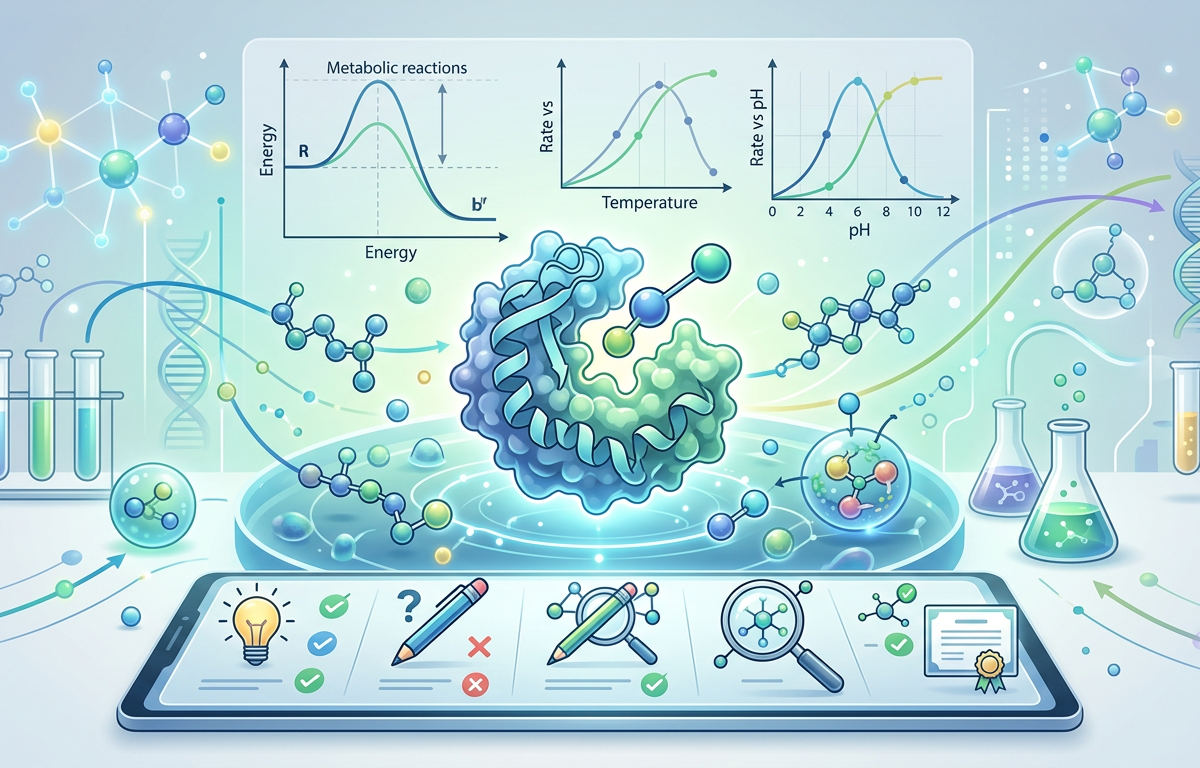
Enzymes are biological catalysts, primarily composed of proteins, that accelerate chemical reactions by lowering the activation energy required for the reaction to occur. Without these specialized molecules, the biochemical processes necessary for life would happen too slowly to sustain organisms. Enzymes function by binding to specific molecules called substrates at a unique location known as the active site. This interaction often follows the "induced fit" model, where the enzyme slightly changes its shape to grip the substrate more securely, facilitating the breaking or forming of chemical bonds.
Understanding enzymes is a cornerstone of biology, much like mastering DNA replication questions or learning how organelles function within a cell. Several factors influence enzyme activity, including temperature, pH levels, and the concentration of both enzymes and substrates. For example, most human enzymes have an optimal temperature of around 37°C; however, extreme heat can cause denaturation, where the enzyme loses its three-dimensional structure and becomes non-functional. Additionally, enzymes are highly specific, meaning a single enzyme typically catalyzes only one type of chemical reaction. This specificity is why we have thousands of different enzymes throughout our organ systems, each performing a distinct role in metabolism, digestion, and DNA synthesis.
Solved Examples
Reviewing solved enzyme questions helps clarify how these biological catalysts interact with their environment and substrates.
Example 1: Calculating Reaction Rate
A scientist observes that an enzyme converts 120 micromoles of substrate into product over a period of 2 minutes. What is the rate of reaction?Identify the total product formed: 120 micromoles.
Identify the total time taken: 2 minutes.
Divide the product by the time: 120 / 2 = 60 micromoles per minute.
The reaction rate is 60 μmol/min.
Example 2: Determining Optimal pH
An experiment tests the activity of Pepsin (a stomach enzyme) at pH 2, pH 7, and pH 10. The highest activity is recorded at pH 2. Why is this expected?Recognize that Pepsin functions in the highly acidic environment of the stomach.
Understand that enzymes evolve to have an optimal pH that matches their natural environment.
Conclude that pH 2 provides the ideal hydrogen ion concentration for Pepsin to maintain its functional tertiary structure.
Example 3: Competitive Inhibition
If a molecule resembles a substrate and binds to the active site, preventing the real substrate from entering, what happens to the Vmax (maximum velocity) of the reaction?Identify the type of inhibition: Competitive.
Recall that competitive inhibitors compete for the active site but do not change the enzyme's capacity to process substrate if the substrate concentration is high enough.
Conclude that while the Km (affinity) increases, the Vmax remains unchanged because the inhibition can be overcome by adding more substrate.
Practice Questions
Test your knowledge with these enzyme questions ranging from basic definitions to complex kinetic scenarios.
What is the name of the specific region on an enzyme where the substrate binds?
Explain the difference between an anabolic and a catabolic reaction in terms of enzyme function.
An enzyme is heated to 80°C, and its activity drops to zero. What has happened to the protein structure?
Start Learning Smarter Today
Join thousands of students using AI-powered study tools to achieve better results.
Get Started FreeHow does an increase in substrate concentration affect the rate of an enzyme-catalyzed reaction when the enzyme is already saturated?
Which type of inhibitor binds to a site other than the active site, changing the enzyme's shape?
What is a cofactor, and how does it differ from a coenzyme?
In the lock-and-key model, what does the "key" represent?
Describe the effect of a competitive inhibitor on the Michaelis-Menten constant (Km).
Why does an enzyme's activity typically decrease significantly at very low temperatures?
True or False: Enzymes are consumed during a chemical reaction and must be replaced.
Answers & Explanations
1. Active Site: The active site is a pocket or groove on the enzyme surface where the substrate fits. Its shape is highly specific to the substrate.
2. Anabolic vs. Catabolic: Anabolic reactions use enzymes to build larger molecules from smaller ones (requiring energy), while catabolic reactions use enzymes to break down large molecules into smaller ones (releasing energy).
3. Denaturation: High heat disrupts the hydrogen bonds and hydrophobic interactions that maintain the enzyme's tertiary structure, causing it to unfold and lose its functional shape.
4. No Change: Once all active sites are occupied (saturation), adding more substrate will not increase the rate because the enzymes are already working at their maximum capacity (Vmax).
5. Non-competitive Inhibitor: These bind to an allosteric site, which alters the enzyme's conformation so the active site no longer functions effectively.
6. Cofactors vs. Coenzymes: Cofactors are inorganic ions (like Zinc or Iron), while coenzymes are organic molecules (like vitamins) that assist enzyme function. According to the Nature Journal, these are essential for the catalytic activity of many proteins.
7. The Substrate: In the lock-and-key analogy, the enzyme is the lock and the substrate is the key that fits perfectly into it.
8. Increase in Km: A competitive inhibitor increases the Km because more substrate is required to reach half of the maximum velocity, as the substrate must compete with the inhibitor.
9. Low Kinetic Energy: At low temperatures, molecules move more slowly, leading to fewer collisions between enzymes and substrates, thus reducing the reaction rate.
10. False: Enzymes are catalysts; they emerge from the reaction unchanged and can be reused multiple times.
1. Which statement best describes how enzymes affect the activation energy of a reaction?
Frequently Asked Questions
What are enzymes made of?
Most enzymes are made of amino acids linked together in long chains that fold into specific three-dimensional protein structures. While some RNA molecules (ribozymes) can act as catalysts, the vast majority of biological enzymes are proteins.
Can enzymes work in any environment?
No, enzymes are highly sensitive to their environment and typically have an optimal temperature and pH range. If conditions stray too far from these optima, the enzyme may denature and lose its ability to catalyze reactions.
What is the induced fit model?
The induced fit model suggests that the active site of an enzyme is not a rigid shape but rather a flexible structure that adjusts its shape to bind the substrate more tightly. This refinement of the lock-and-key model explains how enzymes stabilize the transition state of a reaction.
Are enzymes used up in a reaction?
Enzymes are not consumed or permanently altered during the chemical reactions they catalyze. After a product is released, the enzyme is free to bind to a new substrate molecule and repeat the process indefinitely until it eventually degrades.
How do inhibitors affect enzyme activity?
Inhibitors are molecules that decrease enzyme activity by either blocking the active site (competitive inhibition) or binding elsewhere on the enzyme to change its shape (non-competitive inhibition). This process is vital for regulating metabolic pathways in the body.
Why is enzyme specificity important?
Enzyme specificity ensures that the correct chemical reactions occur at the right time within a cell, preventing chaotic or unwanted biochemical side effects. This precision allows the body to control complex metabolic networks with high efficiency.
Start Learning Smarter Today
Join thousands of students using AI-powered study tools to achieve better results.
Get Started FreeEnjoyed this article?
Share it with others who might find it helpful.
Related Articles

Hard Enzyme Questions Practice Questions
Master complex biochemistry with these hard enzyme questions. Cover Michaelis-Menten kinetics, inhibition types, and Lineweaver-Burk plots with solved examples.
Apr 26, 2026

Medium Enzyme Questions Practice Questions
Master enzyme kinetics and regulation with our Medium Enzyme Questions Practice Questions. Includes solved examples, detailed explanations, and a quick quiz.
Apr 26, 2026
Hard Microbiology Practice Questions Practice Questions
Hard Microbiology Practice Questions Practice Questions
Apr 26, 2026
Medium Microbiology Practice Questions Practice Questions
Master microbiology with our medium-level practice questions covering bacterial growth, genetics, and metabolism. Includes solved examples and a quick quiz.
Apr 26, 2026

Easy Microbiology Practice Questions Practice Questions
Easy Microbiology Practice Questions Practice Questions
Apr 26, 2026

Microbiology Practice Questions Practice Questions with Answers
Master microbiology with our comprehensive guide featuring concept explanations, solved examples, and practice questions with detailed answers.
Apr 26, 2026

Hard Physiology Practice Questions Practice Questions
Dive into hard physiology practice questions to master complex bodily functions, regulatory systems, and cellular mechanisms.
Apr 25, 2026

Medium Physiology Practice Questions Practice Questions
Boost your understanding of physiological processes with these medium physiology practice questions covering homeostasis, organ systems, and cellular functions.
Apr 25, 2026