Easy SAT Triangle Practice Questions

Mastering Easy SAT Triangle Practice Questions is a fundamental step for any student aiming to secure a high score on the SAT Math section. Triangles are among the most frequently tested geometric shapes on the exam, appearing in various forms from basic angle calculations to right-triangle trigonometry. Understanding the core properties of triangles—such as the sum of interior angles, the Pythagorean theorem, and special right triangles—provides a solid foundation for more complex geometry problems.
Concept Explanation
SAT triangle problems focus on the fundamental geometric properties and theorems that govern three-sided polygons. The most essential rule is that the sum of the interior angles of any triangle is always . To solve these problems effectively, you must be familiar with several categories of triangles and their unique characteristics. For more foundational algebra practice, you might also find our guide on Easy SAT Linear Equations Practice Questions helpful.
Key Triangle Properties
- Isosceles Triangles: These have at least two equal sides and two equal angles opposite those sides.
- Equilateral Triangles: All three sides are equal, and every interior angle is exactly .
- Right Triangles: One angle is exactly . The relationship between the sides is defined by the Pythagorean theorem: where is the hypotenuse.
- Triangle Inequality Theorem: The sum of the lengths of any two sides of a triangle must be greater than the length of the third side.
Special Right Triangles
The SAT often includes "special" right triangles that allow for quick calculations without the Pythagorean theorem. These include the triangle (with side ratios ) and the triangle (with side ratios ). Familiarizing yourself with these ratios, as explained on Khan Academy, can save significant time during the test.
Solved Examples
Reviewing these worked examples will help you understand how to apply basic triangle rules to common SAT-style questions.
- Example 1: Finding a Missing Angle
In triangle , the measure of angle is and the measure of angle is . What is the measure of angle ?- Recall that the sum of angles in a triangle is .
- Set up the equation: .
- Combine the known angles: .
- Subtract 120 from both sides: .
- Example 2: Using the Pythagorean Theorem
A right triangle has legs of length 3 and 4. What is the length of the hypotenuse?- Identify the legs as and .
- Apply the formula .
- Calculate the squares: .
- Take the square root: . The hypotenuse is 5.
- Example 3: Isosceles Triangle Properties
In an isosceles triangle, the vertex angle measures . What is the measure of one of the base angles?- The two base angles in an isosceles triangle are equal. Let each be .
- The sum of angles is .
- Simplify: .
- Solve for : , so .
Practice Questions
Test your skills with these Easy SAT Triangle Practice Questions. If you find these concepts intuitive, you might want to challenge yourself with SAT Math Practice Questions Set 3.
- A triangle has angles measuring , , and . What is the value of ?
- In a right triangle, one acute angle measures . What is the measure of the other acute angle?
- An equilateral triangle has a perimeter of 24 units. What is the length of one side?
- A right triangle has a hypotenuse of length 13 and one leg of length 5. What is the length of the other leg?
- The sides of a triangle are 7, 10, and . Which of the following could NOT be the value of ?
- A) 4
- B) 10
- C) 15
- D) 18
- In triangle , . If the measure of angle is , what is the measure of angle ?
- What is the area of a right triangle with a base of 6 and a height of 8?
- If a triangle has a hypotenuse of 10, what is the length of the shortest side?
- Two triangles are similar. The sides of the smaller triangle are 3, 4, and 5. If the longest side of the larger triangle is 15, what is its perimeter?
- In triangle , the exterior angle at vertex measures . If angle measures , what is the measure of angle ?
Answers & Explanations
- Answer: 90
The sum of angles in a triangle is . Thus, . Solving for , we get , so . - Answer: 55
In a right triangle, the two acute angles sum to . Therefore, . - Answer: 8
An equilateral triangle has three equal sides. If the perimeter is 24, then each side is . - Answer: 12
Using the Pythagorean theorem: . This results in . Subtracting 25 gives , so . This is a common 5-12-13 Pythagorean triple. - Answer: D (18)
According to the triangle inequality theorem, the sum of any two sides must be greater than the third side. Here, . Since 17 is not greater than 18, a triangle with sides 7, 10, and 18 cannot exist. - Answer: 65
Since , triangle is isosceles with base angles and . . Since the base angles are equal, . - Answer: 24
The area of a triangle is . So, . - Answer: 5
In a triangle, the side opposite the angle (the shortest side) is half the length of the hypotenuse. . - Answer: 36
The larger triangle is similar to the 3-4-5 triangle. Since the longest side (hypotenuse) is 15, the scale factor is . The perimeter of the small triangle is . The perimeter of the larger triangle is . - Answer: 70
An exterior angle of a triangle is equal to the sum of the two opposite interior angles. So, . , which means .
1. What is the sum of the interior angles of any triangle?
Frequently Asked Questions
What is the most important triangle rule for the SAT?
The most important rule is that the interior angles of a triangle always sum to . This rule is the basis for solving many geometry problems on the test.
How do I identify an isosceles triangle on the SAT?
An isosceles triangle is identified by having two equal sides or two equal angles. If the SAT states that two sides are congruent, you can immediately conclude the opposite angles are also equal.
What are Pythagorean triples?
Pythagorean triples are sets of three integers that satisfy the equation . Common triples on the SAT include 3-4-5, 5-12-13, and 8-15-17.
Do I need to memorize the area formula for a triangle?
Yes, you should know that the area is . Note that the height must be perpendicular to the base.
What is the Triangle Inequality Theorem?
This theorem states that the sum of the lengths of any two sides of a triangle must be strictly greater than the length of the third side. This is often used to find the possible range of a missing side length.
Are special right triangle formulas provided on the SAT?
Yes, the SAT provides a reference sheet at the beginning of each math section that includes the ratios for and triangles. However, memorizing them will save you time.
Enjoyed this article?
Share it with others who might find it helpful.
Related Articles
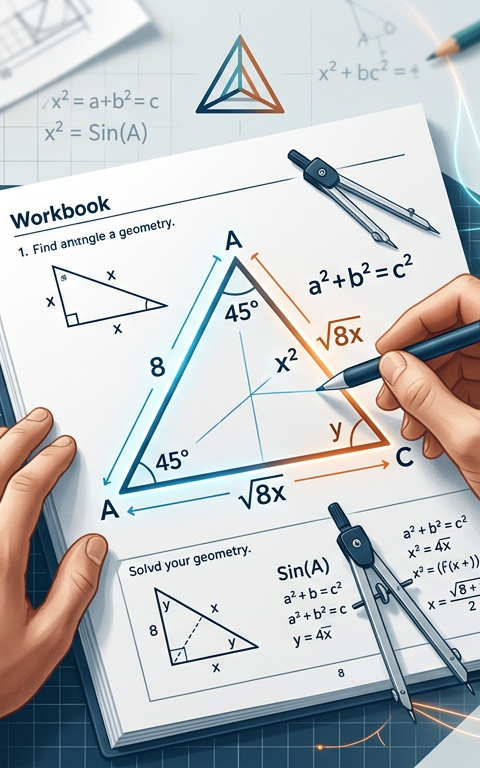
Medium SAT Triangle Practice Questions
Medium SAT Triangle Practice Questions
Apr 27, 2026

SAT Triangle Practice Questions with Answers
SAT Triangle Practice Questions with Answers
Apr 27, 2026
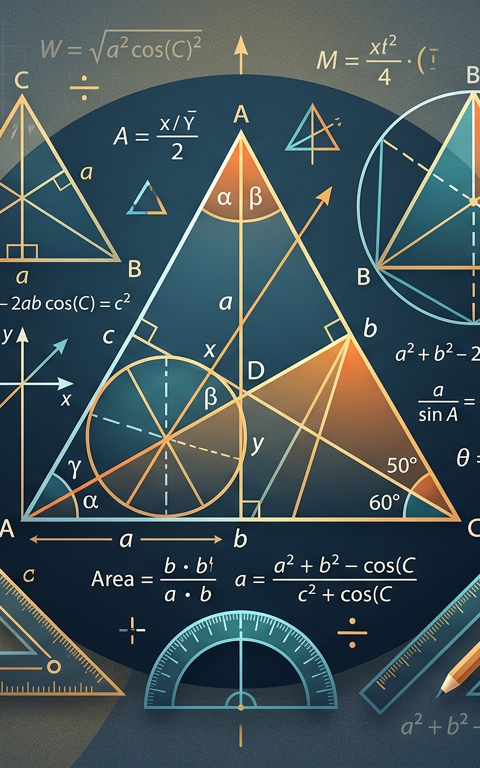
Solving the Hidden Geometry Traps in SAT Triangle Problems
Hard SAT Triangle Practice Questions
Apr 27, 2026
Solving High-Level SAT Integer Logic and Number Theory Problems
Hard SAT Integers Practice Questions
Apr 27, 2026

Hard SAT Number Properties Practice Questions
Hard SAT Number Properties Practice Questions
Apr 27, 2026

Defeating Extraneous Solutions and Rational Exponents on the SAT
Hard SAT Radicals Practice Questions
Apr 27, 2026
Hard SAT Exponents Practice Questions
Hard SAT Exponents Practice Questions
Apr 27, 2026

Hard SAT Percent Practice Questions
Hard SAT Percent Practice Questions
Apr 27, 2026