Easy SAT Probability Practice Questions
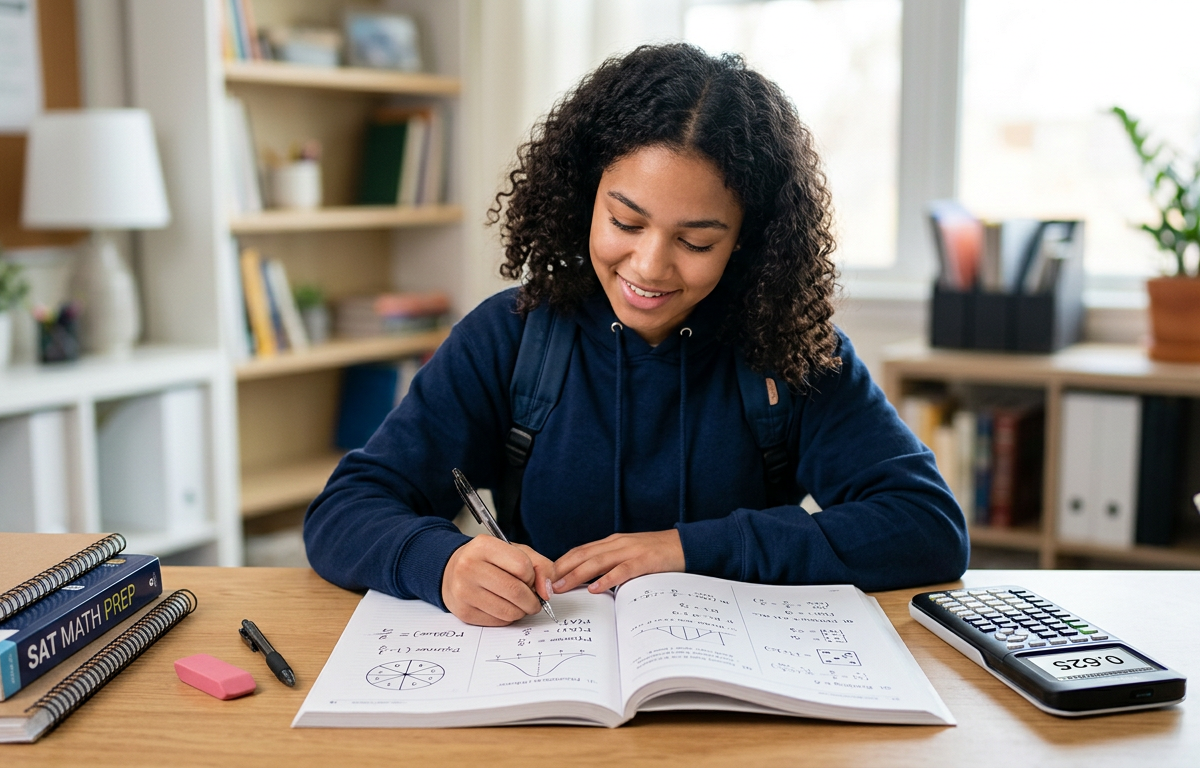
1. **Concept Explanation**
SAT probability is a measure of the likelihood that a specific event will occur, expressed as a ratio of the number of favorable outcomes to the total number of possible outcomes. On the SAT, probability questions typically focus on simple events, data tables, and basic counting principles. The fundamental formula you need to remember is:
Probabilities are always represented as a number between 0 and 1, inclusive. A probability of 0 means the event is impossible, while a probability of 1 means the event is certain. You can express these values as fractions, decimals, or percentages. For example, a 50% chance is the same as or . Many easy SAT word problems involve reading a table and selecting a specific group. If a question asks for the probability of picking a student who is a senior given they are in the band, your "total outcomes" (the denominator) becomes only the students in the band, not the entire school. This is known as conditional probability. Mastering these basics is essential before moving on to more complex topics like ratio and proportion or linear equations.
2. **Solved Examples**
Review these step-by-step solutions to understand how to apply the probability formula in different SAT contexts.
- Example 1: Basic Marbles
A bag contains 4 red marbles, 5 blue marbles, and 11 green marbles. If one marble is selected at random, what is the probability that it is blue?
- Identify the number of favorable outcomes: There are 5 blue marbles.
- Calculate the total number of outcomes: total marbles.
- Apply the formula: .
- Simplify the fraction: or 0.25.
- Example 2: Data Table Probability
If a person is chosen at random from Group A, what is the probability they passed?Group Passed Failed Group A 15 5 Group B 18 2
- Identify the specific population: The question asks for someone "from Group A." This means the total is the sum of Group A only.
- Calculate total for Group A: .
- Identify favorable outcomes: 15 people in Group A passed.
- Final calculation: or 0.75.
- Example 3: Complementary Events
The probability that it will rain tomorrow is . What is the probability that it will NOT rain tomorrow?
- Recognize that the sum of all possible probabilities is 1.
- Subtract the given probability from 1: .
- Calculate: .
- The answer is 0.7 or 70%.
3. **Practice Questions**
Test your skills with these Easy SAT Probability Practice Questions. Ensure you read the tables carefully!
1. A spinner is divided into 8 equal sections numbered 1 through 8. What is the probability that the spinner lands on a number greater than 5?
2. A jar contains 12 caramels, 8 peppermint drops, and 10 chocolates. If one candy is picked at random, what is the probability it is NOT a chocolate?
3. In a class of 30 students, 12 play soccer, 8 play basketball, and the rest do not play a sport. If a student is chosen at random, what is the probability the student does not play a sport?
4. A box contains 50 light bulbs. If 4 of the bulbs are defective, what is the probability that a bulb selected at random will be functional?
5. The table below shows the distribution of a group of 400 people by blood type.
| Blood Type | Number of People |
|---|---|
| A | 160 |
| B | 40 |
| AB | 30 |
| O | 170 |
What is the probability that a person chosen at random from this group has Type B blood?
6. If a fair six-sided die is rolled, what is the probability of rolling an even number?
7. A set of cards includes 5 red cards, 3 yellow cards, and 2 green cards. If two cards are drawn with replacement, what is the probability that both cards are green?
8. A survey asked 100 people about their preferred pet. 45 said dogs, 35 said cats, and 20 said birds. What is the probability that a person chosen at random prefers a cat or a bird?
9. A computer randomly selects an integer from 1 to 20. What is the probability that the integer is a prime number?
10. In a survey of 80 residents, 24 reported they walk to work. What is the probability that a resident chosen at random does NOT walk to work?
4. **Answers & Explanations**
- Answer: . Numbers greater than 5 are 6, 7, and 8 (3 outcomes). Total outcomes = 8. Probability = .
- Answer: . Total candies = . Non-chocolates = . Probability = .
- Answer: . Students with no sport = . Probability = .
- Answer: 0.92. Functional bulbs = . Probability = .
- Answer: 0.1. Type B count = 40. Total = 400. Probability = .
- Answer: . Even numbers on a die are 2, 4, and 6 (3 outcomes). Total = 6. Probability = .
- Answer: . Total cards = 10. Probability of green is . Since it is with replacement, the second draw is also . .
- Answer: 0.55. Cat (35) + Bird (20) = 55. Total = 100. Probability = .
- Answer: . Prime numbers between 1 and 20 are 2, 3, 5, 7, 11, 13, 17, 19 (8 total). Probability = .
- Answer: 0.7. Residents who don't walk = . Probability = .
1. If a bag contains 3 red, 4 blue, and 5 white marbles, what is the probability of picking a marble that is NOT red?
6. **Frequently Asked Questions**
What is the difference between experimental and theoretical probability?
Theoretical probability is based on reasoning or the number of possible outcomes in a perfect scenario, whereas experimental probability is based on the actual results of an experiment or trial. Both are calculated using the same basic ratio formula but use different data sources.
Can a probability be a negative number?
No, a probability cannot be negative because it represents a count of outcomes relative to a total. The range for any probability is strictly between 0 (impossible) and 1 (certainty).
How do I handle "given that" questions on the SAT?
When you see "given that," you must restrict your denominator to the group specified after those words. This is a common tactic on the SAT to test if students can correctly identify the subset of a population from a table.
What does it mean to pick an item "with replacement"?
Picking with replacement means that after an item is selected, it is put back into the pool before the next selection. This keeps the total number of outcomes and the probability of each event constant for every draw.
How do I convert a fraction probability to a percentage?
To convert a fraction to a percentage, divide the numerator by the denominator to get a decimal and then multiply by 100. For more practice with decimals and percentages, you can check out easy SAT percentage word practice questions.
Enjoyed this article?
Share it with others who might find it helpful.
Related Articles

Hard SAT Probability Practice Questions
Hard SAT Probability Practice Questions
Apr 27, 2026
Medium SAT Probability Practice Questions
Medium SAT Probability Practice Questions
Apr 27, 2026

Hard SAT Standard Deviation Practice Questions
Hard SAT Standard Deviation Practice Questions
Apr 27, 2026

Solving Weighted Averages and Median Shifts on the Digital SAT
Hard SAT Mean Median Mode Practice Questions
Apr 27, 2026

SAT Stats: Solving for Margin of Error and Skewed Distributions
Hard SAT Statistics Practice Questions
Apr 27, 2026

Medium SAT Standard Deviation Practice Questions
Medium SAT Standard Deviation Practice Questions
Apr 27, 2026

Medium SAT Statistics Practice Questions
Medium SAT Statistics Practice Questions
Apr 27, 2026

Easy SAT Standard Deviation Practice Questions
Easy SAT Standard Deviation Practice Questions
Apr 27, 2026