Easy SAT Geometry Practice Questions
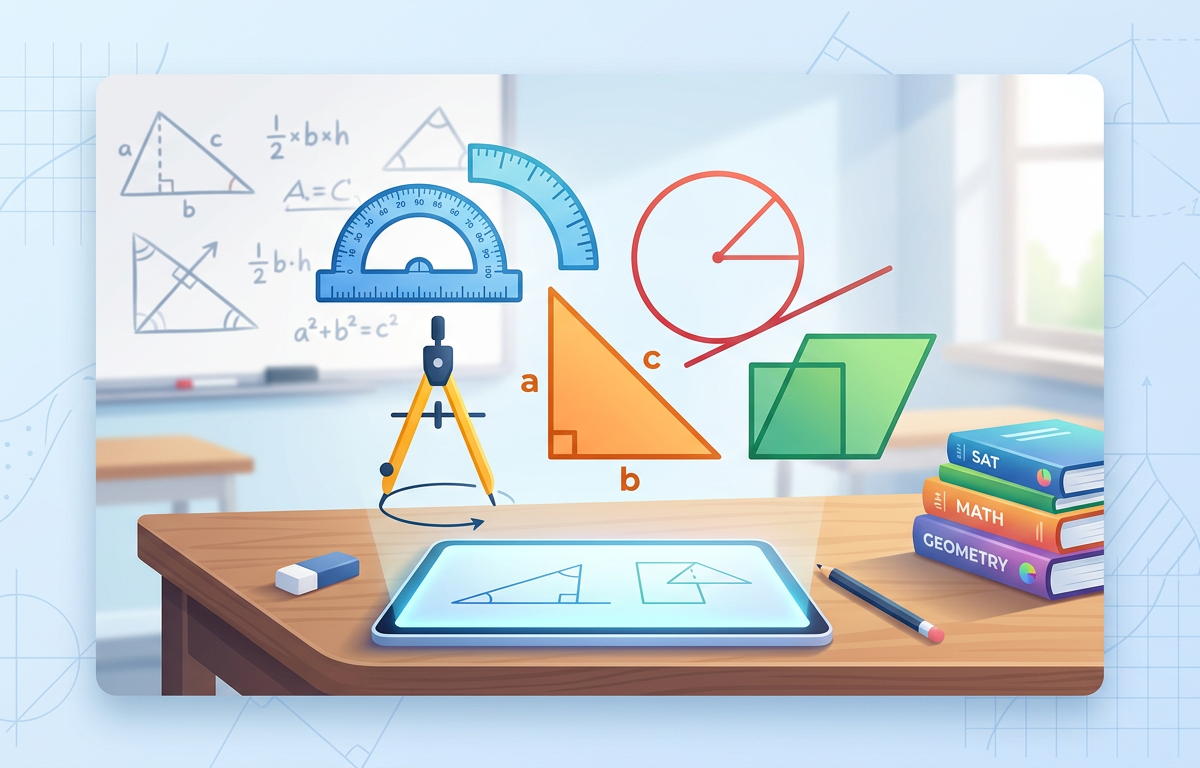
Easy SAT Geometry Practice Questions
Mastering basic geometry is a fundamental step toward achieving a high score on the SAT Math section. While many students focus heavily on algebra, geometry and trigonometry typically account for approximately 15% of the exam, making it essential to understand properties of lines, angles, triangles, circles, and three-dimensional shapes.
Concept Explanation
SAT Geometry covers the properties and relations of points, lines, surfaces, and solids, focusing primarily on Euclidean geometry in a two-dimensional plane. To succeed in this section, you must be familiar with the reference sheet provided during the exam, which includes formulas for the area of circles, triangles, and rectangles, as well as the volume of cylinders, spheres, and prisms. Key concepts include the Pythagorean theorem , the fact that the sum of interior angles in a triangle is always , and the properties of parallel lines intersected by a transversal. If you are also preparing for other math sections, you might find our Easy SAT Linear Equations Practice Questions helpful for building a strong algebraic foundation.
Triangles and Angles
Triangles are the most frequently tested shape. You should recognize special right triangles, such as the and triangles. Additionally, understanding similar triangles—where corresponding angles are equal and sides are proportional—is a common requirement for solving "easy" level problems. According to the College Board, these core geometric principles are designed to test your ability to apply logical reasoning to spatial problems.
Circles and Volume
For circles, you need to know the relationship between the radius, diameter, circumference , and area . Many questions involve finding arc lengths or the area of sectors using proportions. For 3D geometry, the SAT generally sticks to basic volume calculations. You can explore more complex word-based scenarios in our guide on Easy SAT Word Problems Practice Questions.
Solved Examples
Review these step-by-step solutions to understand how to approach common geometry problems on the SAT.
- Example 1: Triangle Angles
In triangle , the measure of angle is and the measure of angle is . What is the measure of angle ?- Recall that the sum of the interior angles of any triangle is .
- Set up the equation: .
- Combine the known angles: .
- Subtract 120 from both sides: .
- Example 2: Pythagorean Theorem
A right triangle has legs with lengths 6 and 8. What is the length of the hypotenuse?- Use the Pythagorean theorem:
- Substitute the leg lengths: .
- Calculate the squares: .
- Sum the values: .
- Take the square root: .
- Example 3: Area of a Circle
A circle has a diameter of 10. What is its area in terms of ?- Identify the radius. Since the diameter is 10, the radius is .
- Use the area formula: .
- Substitute the radius: .
- Simplify: .
Practice Questions
Test your knowledge with these 10 practice questions. These are designed to mimic the difficulty of the easier geometry questions found in the first half of an SAT Math module.
1. In a rectangle, the length is 12 and the width is 5. What is the length of the diagonal?
2. A square has a perimeter of 32. What is the area of the square?
3. Two angles are supplementary. If one angle measures , what is the measure of the other angle?
4. A circle has a circumference of . What is the radius of the circle?
5. In , and . If the side opposite has a length of 4, what is the length of the hypotenuse ?
6. A rectangular prism has a length of 4, a width of 3, and a height of 10. What is its volume?
7. If two lines intersect and one of the vertical angles formed is , what is the measure of the angle adjacent to it?
8. An equilateral triangle has a side length of 10. What is the perimeter of the triangle?
9. A cylinder has a radius of 3 and a height of 5. What is the volume of the cylinder in terms of ?
10. In a coordinate plane, what is the distance between the points and ?
Answers & Explanations
- 13: Use the Pythagorean theorem for the diagonal of the rectangle: . This gives , and .
- 64: If the perimeter is 32, each side is . The area is , so .
- 65°: Supplementary angles add up to . Therefore, .
- 8: The formula for circumference is . Set . Dividing both sides by gives .
- 8: In a triangle, the hypotenuse is twice the length of the shorter leg (the side opposite the angle). Since the short leg is 4, the hypotenuse is .
- 120: Volume of a rectangular prism is . So, .
- 138°: Angles on a straight line are supplementary. If one angle is , the adjacent angle is .
- 30: An equilateral triangle has three equal sides. .
- 45π: The volume of a cylinder is . Here, .
- 5: Use the distance formula: .
1. What is the sum of the exterior angles of any convex polygon?
Frequently Asked Questions
Is a formula sheet provided for geometry on the SAT?
Yes, the SAT provides a reference sheet at the beginning of every math section containing formulas for area, volume, and basic trigonometry. You do not need to memorize the volume of a cone or sphere, but knowing them by heart can save valuable time during the test.
How much of the SAT Math section is geometry?
Geometry and Trigonometry make up approximately 15% of the total math questions on the SAT. This equates to about 8 to 10 questions across the entire exam, focusing on both 2D and 3D shapes. For more balanced prep, check out our Easy SAT Ratio and Proportion Practice Questions.
What are the most important geometry theorems to know?
The most critical theorems are the Pythagorean Theorem for right triangles and the Triangle Inequality Theorem. You should also understand the properties of parallel lines and transversals, such as alternate interior angles, which are frequently tested. Resources like Khan Academy offer excellent drills on these specific rules.
Do I need to know trigonometry for SAT geometry questions?
Yes, basic trigonometry (SOH CAH TOA) is included in the Geometry and Trigonometry category. You should know how to find the sine, cosine, and tangent of an angle in a right triangle, as well as the relationship between sine and cosine of complementary angles.
How can I improve my speed on geometry questions?
Improving speed requires recognizing common patterns, such as Pythagorean triples (3-4-5, 5-12-13) and special right triangle ratios. Practicing with a variety of problems, including Euclidean geometry fundamentals, will help you identify these shortcuts instantly.
Enjoyed this article?
Share it with others who might find it helpful.
Related Articles
Medium SAT Geometry Practice Questions
Medium SAT Geometry Practice Questions
Apr 27, 2026
SAT Geometry Practice Questions with Answers
SAT Geometry Practice Questions with Answers
Apr 27, 2026

Hard SAT Geometry Word Practice Questions
Hard SAT Geometry Word Practice Questions
Apr 27, 2026
Hard SAT Coordinate Geometry Practice Questions
Hard SAT Coordinate Geometry Practice Questions
Apr 27, 2026
Solving the Hidden Geometry Traps in SAT Triangle Problems
Hard SAT Triangle Practice Questions
Apr 27, 2026

Medium SAT Geometry Word Practice Questions
Medium SAT Geometry Word Practice Questions
Apr 27, 2026
Medium SAT Coordinate Geometry Practice Questions
Medium SAT Coordinate Geometry Practice Questions
Apr 27, 2026
Easy SAT Geometry Word Practice Questions
Easy SAT Geometry Word Practice Questions
Apr 27, 2026