Easy Protein Structure Questions Practice Questions
Concept Explanation
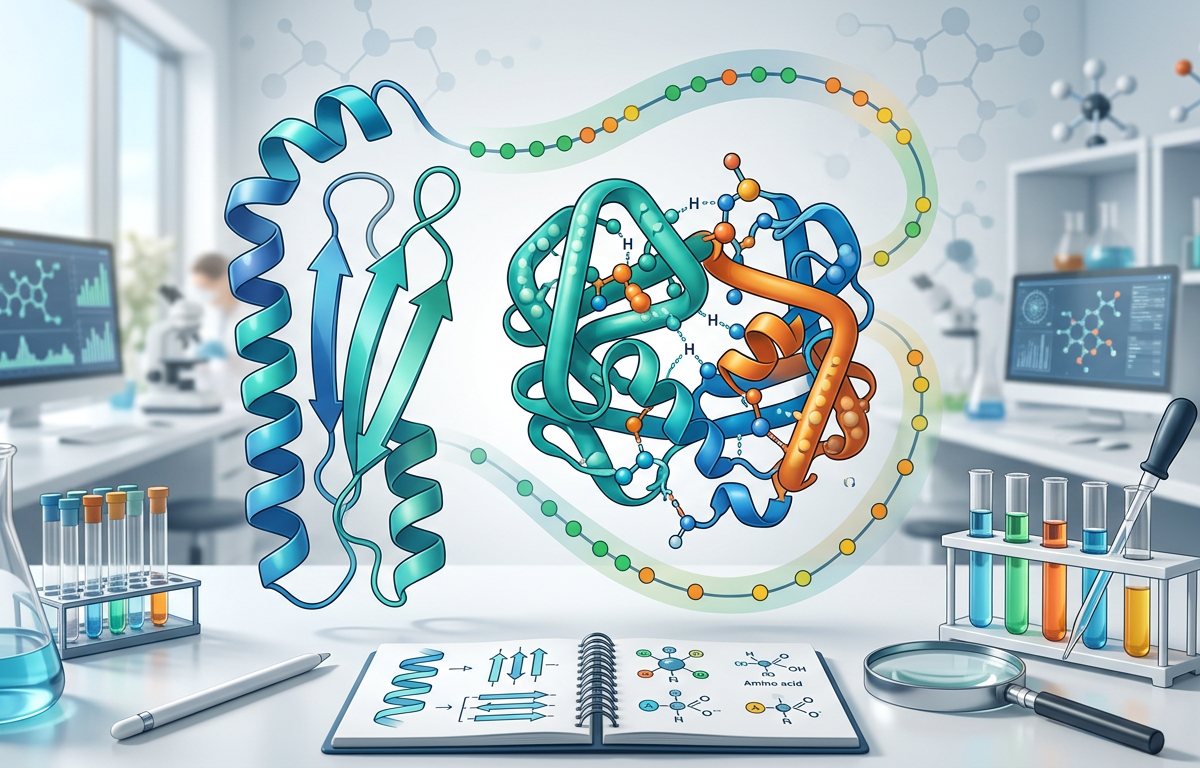
Protein structure is the specific three-dimensional arrangement of amino acids in a polypeptide chain that determines a protein's unique biological function. Proteins are the workhorses of the cell, and their ability to act as enzymes, structural supports, or signaling molecules depends entirely on their shape. This shape is organized into four distinct levels: primary, secondary, tertiary, and quaternary. The primary structure is the linear sequence of amino acids held together by peptide bonds. Secondary structure refers to local folding patterns like alpha-helices and beta-pleated sheets, stabilized by hydrogen bonds. Tertiary structure is the overall 3D shape of a single polypeptide, while quaternary structure involves the assembly of multiple polypeptide subunits. Just as understanding cell structure is vital for biology, mastering protein levels is essential for biochemistry. You can find more detailed scientific resources on this at Nature Education.
Solved Examples
Reviewing these solved examples will help you understand how to approach easy protein structure questions by breaking down the chemical bonds involved.
- Identify the bond responsible for maintaining the primary structure of a protein.
- The primary structure is the sequence of amino acids.
- Amino acids are linked together through dehydration synthesis.
- This specific covalent link is called a peptide bond.
- Which level of protein structure is characterized by alpha-helices and beta-pleated sheets?
- Alpha-helices and beta-sheets are local folding patterns.
- These patterns are stabilized by hydrogen bonds between the backbone atoms.
- Therefore, these represent the secondary structure.
- If a protein consists of four separate polypeptide chains working together, what level of structure is being described?
- A single chain represents up to tertiary structure.
- The interaction between multiple subunits (chains) is the highest level of organization.
- This is known as the quaternary structure.
Practice Questions
- What is the basic building block (monomer) of a protein?
- Which chemical bond connects the carboxyl group of one amino acid to the amino group of another?
- What type of bonding is primarily responsible for stabilizing the secondary structure of a protein?
- True or False: The primary structure of a protein is determined by the genetic information in DNA.
- What term describes the unfolding of a protein, leading to a loss of its biological activity?
- Which level of structure is defined by the overall 3D shape of a single polypeptide chain, including interactions between R-groups?
- Hemoglobin consists of four subunits. This is an example of which level of protein structure?
- Which part of an amino acid's structure varies between the 20 different common amino acids?
- Hydrophobic interactions usually drive non-polar side chains to the interior of a protein. This occurs during which level of folding?
- In a beta-pleated sheet, are the hydrogen bonds parallel or perpendicular to the polypeptide backbone?
Answers & Explanations
- Amino Acids: These are the monomers that link together to form polypeptides. There are 20 standard amino acids used by cells.
- Peptide Bond: This is a covalent bond formed between the carbon of a carboxyl group and the nitrogen of an amino group via a condensation reaction.
- Hydrogen Bonds: These occur between the oxygen of the carbonyl group and the hydrogen of the amino group within the polypeptide backbone, creating helices or sheets.
- True: The sequence of nucleotides in a gene dictates the sequence of amino acids, much like how DNA replication ensures the genetic code is passed on accurately.
- Denaturation: This process occurs when heat, pH changes, or chemicals disrupt the bonds holding the protein's shape, causing it to lose function.
- Tertiary Structure: This level involves various interactions like disulfide bridges, ionic bonds, and hydrophobic interactions between the Side chains (R-groups).
- Quaternary Structure: This applies only to proteins with more than one polypeptide chain. You can learn more about complex biological systems in our guide on organ system questions.
- The R-group (Side Chain): While the amino and carboxyl groups are constant, the R-group determines the chemical properties (acidic, basic, polar, non-polar) of the amino acid.
- Tertiary Structure: As a protein folds in an aqueous environment, hydrophobic R-groups cluster in the center to avoid water.
- Perpendicular: In beta-sheets, hydrogen bonds form between adjacent strands, running roughly perpendicular to the direction of the chains.
1. Which bond is the strongest and most responsible for maintaining the primary sequence?
Frequently Asked Questions
What is the difference between a polypeptide and a protein?
A polypeptide is a simple linear chain of amino acids, whereas a protein is a polypeptide that has folded into a functional 3D shape. Some proteins consist of multiple polypeptide chains working together.
Can a protein function if its primary structure is changed?
Usually not, because changing even one amino acid can alter how the protein folds, potentially leading to diseases like sickle cell anemia. The primary sequence is the blueprint for all subsequent folding levels.
What are disulfide bridges?
Disulfide bridges are strong covalent bonds formed between the sulfur atoms of two cysteine amino acids. They play a critical role in stabilizing the tertiary and quaternary structures of many proteins.
Why does heat denature proteins?
Heat increases kinetic energy, causing the atoms in a protein to vibrate rapidly. This vibration eventually breaks the relatively weak hydrogen bonds and hydrophobic interactions that maintain the protein's shape.
How many levels of structure do all proteins have?
All functional proteins have at least three levels of structure: primary, secondary, and tertiary. Only proteins composed of multiple polypeptide subunits possess a quaternary structure.
Enjoyed this article?
Share it with others who might find it helpful.
Related Articles
Hard Le Chatelier’s Principle Practice Questions
Master Hard Le Chatelier’s Principle Practice Questions with our comprehensive guide featuring solved examples, practice problems, and detailed explanations.
Mar 30, 2026

Hard Reaction Quotient (Q) Practice Questions
Hard Reaction Quotient (Q) Practice Questions
Mar 30, 2026
Grams to Moles Practice Questions with Answers
Master grams to moles conversions with our comprehensive guide. Includes step-by-step examples, practice questions, and detailed answers for chemistry students.
Mar 26, 2026
Avogadro’s Number Practice Questions with Answers
Master the mole concept with our Avogadro’s Number practice questions. Includes step-by-step solved examples, a quick quiz, and detailed explanations.
Mar 26, 2026

Empirical Formulas: Solving Ratios from Mass and Percent Data
Master empirical formula calculations with 10 practice questions, worked answers, and a free step-by-step calculator for mass, percentage, and combustion problems.
Mar 26, 2026