Easy Percent Concentration Practice Questions
Concept Explanation
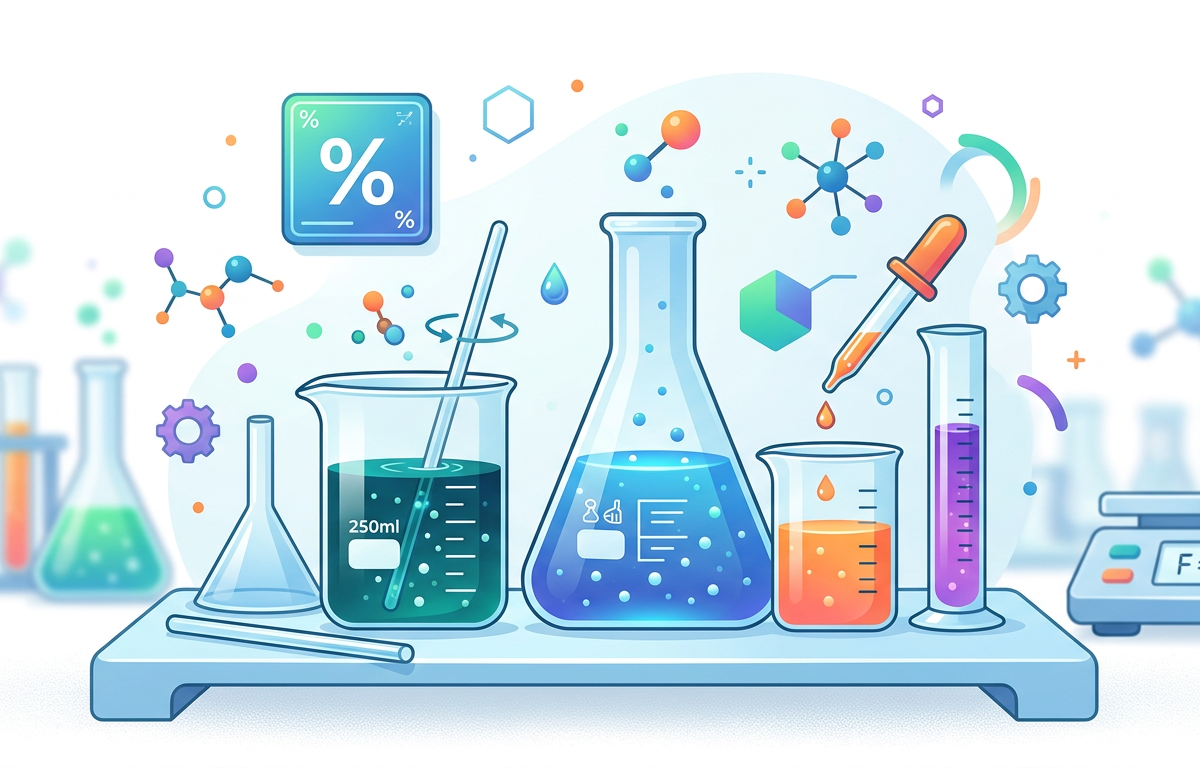
Percent concentration is a measure of the amount of solute present in a specific amount of solution, expressed as a percentage of the total. This fundamental concept in chemistry allows scientists and students to quantify the strength of a mixture. Generally, it is calculated by dividing the mass or volume of the solute by the total mass or volume of the solution and multiplying by 100. Understanding this is a vital precursor to mastering more complex topics like molarity formulas or percentage composition.
There are three common ways to express percent concentration:
Mass Percent (m/m%): Used when both solute and solvent are measured by mass (e.g., grams).
Volume Percent (v/v%): Used when both components are liquids (e.g., milliliters).
Mass/Volume Percent (m/v%): Common in medical settings, measuring grams of solute per 100 mL of solution.
According to LibreTexts Chemistry, the "solution" always refers to the sum of the solute and the solvent. A common mistake is dividing by only the solvent mass. For instance, if you dissolve 5g of salt in 95g of water, the total solution mass is 100g, making it a 5% solution. This concept is essential for laboratory safety and accurate chemical reactions, as detailed in resources from the American Chemical Society.
Solved Examples
Example 1: Calculating Mass Percent
A student dissolves 10 grams of sodium chloride (NaCl) in 90 grams of water. What is the mass percent of the salt solution?
Identify the mass of the solute: 10g.
Identify the mass of the solvent: 90g.
Calculate total solution mass: 10g + 90g = 100g.
Apply the formula: (10g / 100g) × 100 = 10%.
The concentration is 10% (m/m).
Example 2: Volume Percent in Liquids
A bottle contains 40 mL of ethanol mixed with enough water to make a 200 mL total solution. Find the volume percent.
Identify the volume of solute: 40 mL.
Identify the total volume of solution: 200 mL.
Apply the formula: (40 mL / 200 mL) × 100.
Divide 40 by 200 to get 0.2.
Multiply by 100 to get 20% (v/v).
Example 3: Finding Mass from Percent
How many grams of sugar are needed to make 500g of a 5% sugar solution?
Start with the formula: Mass of solute = (Percent / 100) × Total Mass.
Convert percent to decimal: 5 / 100 = 0.05.
Multiply by total solution mass: 0.05 × 500g.
Result: 25 grams of sugar.
Practice Questions
1. A saline solution is prepared by dissolving 3.0g of salt in 97.0g of water. What is the mass percent of the salt?
2. If you mix 25 mL of vinegar with 75 mL of water, what is the volume percent of vinegar in the total 100 mL solution?
3. A chemist needs 250g of a 12% potassium chloride solution. How many grams of potassium chloride solute are required?
Want unlimited practice questions like these?
Generate AI-powered questions with step-by-step solutions on any topic.
Try Question Generator Free →4. What is the mass percent of a solution formed by dissolving 15g of glucose in 135g of water?
5. A 500 mL bottle of rubbing alcohol is labeled as 70% (v/v) isopropyl alcohol. How many milliliters of pure isopropyl alcohol does it contain?
6. You have 8g of copper sulfate. If you want to make a 4% (m/m) solution, what should the total mass of the solution be?
7. A 150g solution contains 15g of solute. What is its percent concentration?
8. Calculate the volume percent of a solution where 10 mL of solute is added to 190 mL of solvent.
9. How much water (solvent) must be added to 20g of salt to create a 10% (m/m) solution?
10. An IV bag contains 0.9% (m/v) NaCl. How many grams of NaCl are in a 1000 mL bag?
Answers & Explanations
3%: Total mass = 3.0g + 97.0g = 100g. (3.0 / 100) × 100 = 3%.
25%: Total volume = 100 mL. (25 / 100) × 100 = 25%.
30g: 12% of 250g = 0.12 × 250 = 30g.
10%: Total mass = 15g + 135g = 150g. (15 / 150) × 100 = 10%.
350 mL: 70% of 500 mL = 0.70 × 500 = 350 mL.
200g: Total mass = Solute / (Percent/100) = 8 / 0.04 = 200g.
10%: (15g / 150g) × 100 = 10%.
5%: Total volume = 10 mL + 190 mL = 200 mL. (10 / 200) × 100 = 5%.
180g: To get 10%, the total mass must be 20 / 0.10 = 200g. Solvent = 200g - 20g = 180g.
9g: 0.9% means 0.9g per 100 mL. For 1000 mL, it is 0.9 × 10 = 9g.
1. Which of the following is the correct formula for mass percent concentration?
Frequently Asked Questions
What is the difference between solute and solvent?
The solute is the substance being dissolved, usually present in a smaller amount, while the solvent is the substance that does the dissolving. Together, they form a homogeneous mixture called a solution.
Can percent concentration be greater than 100%?
No, percent concentration represents a part of a whole, so it cannot exceed 100% in a standard solution. A 100% concentration would mean the substance is pure and not a mixture at all.
How is percent concentration different from molarity?
Percent concentration is based on mass or volume ratios, whereas molarity measures the number of moles of solute per liter of solution. If you need to convert between them, you can check our guide on molarity vs molality.
Why is the total solution mass used instead of just solvent mass?
The total solution mass accounts for the entire physical space and weight of the mixture. Using only the solvent mass would result in an overestimation of the actual concentration percentage.
What are the common units for mass percent?
Mass percent usually uses grams (g) for both the solute and the solution, but any mass unit works as long as they are consistent. For more practice with mass-based calculations, see grams to moles practice questions.
Want unlimited practice questions like these?
Generate AI-powered questions with step-by-step solutions on any topic.
Try Question Generator Free →Enjoyed this article?
Share it with others who might find it helpful.
Related Articles
Hard Le Chatelier’s Principle Practice Questions
Master Hard Le Chatelier’s Principle Practice Questions with our comprehensive guide featuring solved examples, practice problems, and detailed explanations.
Mar 30, 2026
Hard Reaction Quotient (Q) Practice Questions
Hard Reaction Quotient (Q) Practice Questions
Mar 30, 2026
Grams to Moles Practice Questions with Answers
Master grams to moles conversions with our comprehensive guide. Includes step-by-step examples, practice questions, and detailed answers for chemistry students.
Mar 26, 2026
Avogadro’s Number Practice Questions with Answers
Master the mole concept with our Avogadro’s Number practice questions. Includes step-by-step solved examples, a quick quiz, and detailed explanations.
Mar 26, 2026
Empirical Formulas: Solving Ratios from Mass and Percent Data
Master empirical formula calculations with 10 practice questions, worked answers, and a free step-by-step calculator for mass, percentage, and combustion problems.
Mar 26, 2026