Easy MCAT SN1 SN2 Practice Questions
Concept Explanation
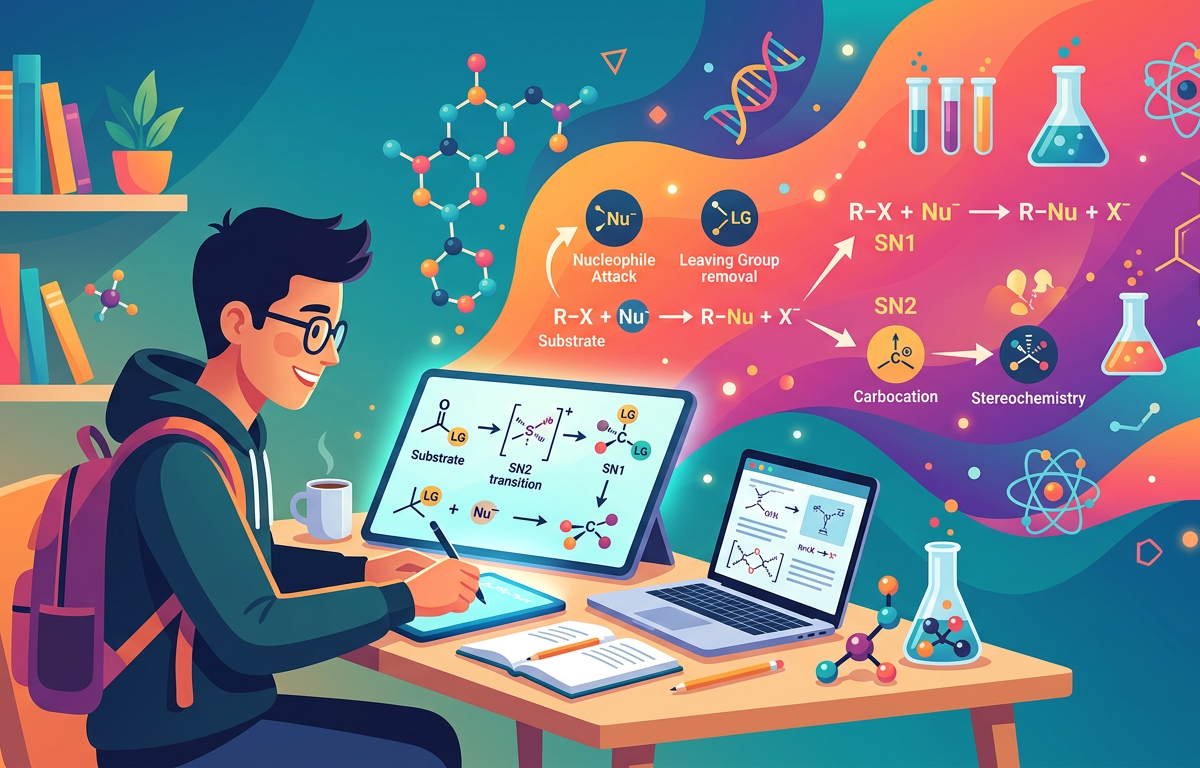
Nucleophilic substitution reactions, specifically SN1 and SN2, are fundamental organic chemistry processes where a nucleophile replaces a leaving group on a carbon atom. These reactions are distinguished by their kinetics, the structure of the substrate, and the stereochemical outcome of the product. Understanding the difference between a unimolecular substitution (SN1) and a bimolecular substitution (SN2) is essential for mastering the chemical foundations of biological systems on the MCAT.
The SN1 reaction (Substitution Nucleophilic Unimolecular) occurs in two distinct steps. First, the leaving group departs to form a carbocation intermediate. Second, the nucleophile attacks this flat carbocation. Because the intermediate is planar, the nucleophile can attack from either side, typically resulting in a racemic mixture (a 50:50 mix of enantiomers). SN1 reactions are favored by tertiary substrates (3°) because they form stable carbocations and are accelerated by polar protic solvents like water or ethanol, which stabilize the charged intermediate.
The SN2 reaction (Substitution Nucleophilic Bimolecular) occurs in a single, concerted step. The nucleophile attacks the electrophilic carbon at the same time the leaving group leaves. This "backside attack" requires the carbon to be relatively unhindered, making primary (1°) and methyl substrates the most reactive. A hallmark of the SN2 mechanism is the inversion of configuration (Walden inversion) at the chiral center. These reactions are favored by strong nucleophiles and polar aprotic solvents like DMSO or acetone, which do not hinder the nucleophile's ability to attack. To improve your retention of these mechanisms, consider using retrieval practice for medical education to solidify the differences in your long-term memory.
| Feature | SN1 Reaction | SN2 Reaction |
|---|---|---|
| Kinetics | First order: Rate = | Second order: Rate = |
| Substrate Preference | 3° > 2° (1° and Methyl never) | Methyl > 1° > 2° (3° never) |
| Stereochemistry | Racemization | Inversion of configuration |
| Solvent | Polar Protic (e.g., H2O, MeOH) | Polar Aprotic (e.g., DMSO, Acetone) |
Solved Examples
- Example 1: Determining Reaction Rate
Predict how the rate of the reaction between 1-bromobutane and sodium hydroxide changes if the concentration of NaOH is doubled.
- Identify the substrate: 1-bromobutane is a primary (1°) alkyl halide.
- Identify the mechanism: Primary substrates favor SN2.
- Apply the rate law: For SN2, Rate = .
- Conclusion: Since the rate is directly proportional to the nucleophile concentration, doubling [NaOH] will double the reaction rate.
- Example 2: Stereochemical Outcome
What is the product configuration when (S)-3-chloro-3-methylhexane reacts with ethanol?
- Identify the substrate: 3-chloro-3-methylhexane is a tertiary (3°) alkyl halide.
- Identify the mechanism: Tertiary substrates undergo SN1.
- Analyze the intermediate: The reaction forms a planar carbocation.
- Conclusion: The ethanol can attack from either side, resulting in a racemic mixture of (R) and (S) configurations.
- Example 3: Solvent Effects
Which solvent, water or DMSO, would better facilitate the reaction of methyl iodide with sodium cyanide?
- Identify the substrate: Methyl iodide is a methyl substrate, favoring SN2.
- Identify the nucleophile: is a strong nucleophile.
- Analyze solvent requirements: SN2 reactions are faster in polar aprotic solvents because they do not solvate the nucleophile strongly.
- Conclusion: DMSO is polar aprotic, while water is polar protic. Therefore, DMSO is the better choice.
Practice Questions
1. Which of the following alkyl halides is most likely to undergo an SN1 reaction?
- A) Methyl chloride
- B) 1-chloropropane
- C) 2-chloropropane
- D) 2-chloro-2-methylpropane
2. If the concentration of the nucleophile is tripled in a reaction following an SN2 mechanism, what happens to the overall rate?
- A) It remains the same
- B) It triples
- C) It increases by a factor of 9
- D) It decreases by a factor of 3
3. Which solvent is considered polar aprotic and is ideal for promoting SN2 reactions?
- A) Ethanol
- B) Acetic acid
- C) Dimethylformamide (DMF)
- D) Ammonia
Study smarter for the MCAT.
Turn practice into performance with AI-powered MCAT tools designed to help students retain more and score higher.
Start Learning Free4. Which of the following statements correctly describes the stereochemistry of an SN2 reaction at a chiral center?
- A) Complete racemization occurs.
- B) The configuration is retained.
- C) The configuration is inverted.
- D) A 75:25 mixture of enantiomers is formed.
5. Which step in the SN1 reaction mechanism is the rate-determining step?
- A) Attack of the nucleophile on the carbocation
- B) Loss of the leaving group to form a carbocation
- C) Deprotonation of the nucleophile
- D) Rearrangement of the carbocation
6. Rank the following leaving groups from best to worst: , , , .
7. Why do primary alkyl halides typically not undergo SN1 reactions?
8. A student performs a reaction with (R)-2-bromobutane and sodium methoxide in methanol. What is the most likely mechanism and product configuration?
Answers & Explanations
- Answer: D. 2-chloro-2-methylpropane is a tertiary alkyl halide. SN1 reactions require the formation of a stable carbocation, and tertiary carbocations are the most stable due to inductive effects and hyperconjugation. This concept is often tested using retrieval practice examples to ensure students can distinguish between substrate types.
- Answer: B. The rate law for an SN2 reaction is Rate = . Because the reaction is first-order with respect to the nucleophile, tripling its concentration will triple the rate.
- Answer: C. DMF is a polar aprotic solvent. Unlike ethanol or acetic acid, it lacks an H-atom bonded to an electronegative atom (N or O), meaning it cannot form hydrogen bonds with the nucleophile. This keeps the nucleophile "naked" and highly reactive for SN2.
- Answer: C. SN2 involves a backside attack. As the nucleophile enters from the side opposite the leaving group, the other three substituents "flip" like an umbrella in the wind, leading to an inversion of configuration.
- Answer: B. The formation of the high-energy carbocation intermediate is the slowest step in the SN1 process. Because it is the slowest, it determines the overall rate of the reaction.
- Answer: I^- > Br^- > Cl^- > F^-. Better leaving groups are weaker bases. Large ions like iodide spread their charge over a larger volume, making them more stable and better leaving groups. This is a common topic in nucleophilic substitution theory.
- Answer: Primary carbocations are extremely unstable. The energy barrier to form a primary carbocation is too high for the reaction to proceed via an SN1 pathway under standard conditions.
- Answer: This is a secondary alkyl halide with a strong nucleophile (methoxide) and a polar protic solvent (methanol). While secondary substrates are on the borderline, the strong nucleophile favors SN2, leading to (S)-2-methoxybutane (inversion). However, methanol may promote some SN1. For the MCAT, strong nucleophiles usually signal SN2 for secondary substrates.
1. Which mechanism is characterized by a first-order rate law?
Frequently Asked Questions
What is the main difference between SN1 and SN2?
The main difference lies in the timing of the mechanism: SN1 is a two-step process involving a carbocation intermediate, while SN2 is a single-step concerted process. Consequently, SN1 rate depends only on the substrate, whereas SN2 rate depends on both the substrate and the nucleophile.
How do I know if a reaction is SN1 or SN2 on the MCAT?
Look at the substrate first: tertiary is almost always SN1, and primary/methyl is almost always SN2. For secondary substrates, check the nucleophile and solvent; strong nucleophiles and aprotic solvents favor SN2, while weak nucleophiles and protic solvents favor SN1.
Why does SN1 result in racemization?
SN1 results in racemization because the carbocation intermediate has a trigonal planar geometry with an empty p-orbital. The nucleophile has an equal probability of attacking from the top or bottom face, creating equal amounts of both enantiomers.
What is a polar aprotic solvent?
A polar aprotic solvent is a liquid that has a dipole moment but lacks O-H or N-H bonds, meaning it cannot donate hydrogen bonds. Examples include acetone, DMSO, and DMF, which are preferred for SN2 reactions.
Can a primary alkyl halide ever undergo SN1?
Generally, no, because primary carbocations are too unstable. The only exceptions occur if the carbocation can be resonance-stabilized, such as in allylic or benzylic primary halides, which can undergo SN1 reactions quite rapidly.
Study smarter for the MCAT.
Turn practice into performance with AI-powered MCAT tools designed to help students retain more and score higher.
Start Learning FreeEnjoyed this article?
Share it with others who might find it helpful.
Related Articles
Hard MCAT SN1 SN2 Practice Questions
Master advanced SN1 and SN2 concepts for the MCAT with these hard practice questions, solved examples, and detailed explanations of kinetics and stereochemistry.
May 11, 2026
MCAT SN1 SN2 Practice Questions with Answers
Master MCAT SN1 and SN2 reactions with our comprehensive guide featuring detailed concept explanations, solved examples, and 12 practice questions with answers.
May 10, 2026

Hard MCAT Philosophy Passage Practice Questions
Master Hard MCAT Philosophy Passage Practice Questions with our comprehensive guide featuring solved examples, practice questions, and expert explanations.
May 17, 2026

Hard MCAT Humanities Passage Practice Questions
Master Hard MCAT Humanities Passage Practice Questions with our comprehensive guide featuring solved examples, practice questions, and expert strategies.
May 17, 2026

Hard MCAT Critical Analysis Practice Questions
Hard MCAT Critical Analysis Practice Questions
May 17, 2026

Hard MCAT Reading Comprehension Practice Questions
Hard MCAT Reading Comprehension Practice Questions
May 17, 2026

Hard MCAT CARS Passage Practice Questions
Master high-difficulty MCAT CARS passages with our expert guide featuring solved examples, practice questions, and detailed logical analysis.
May 17, 2026

Hard MCAT CARS Practice Questions
Master Hard MCAT CARS Practice Questions with our comprehensive guide featuring solved examples, practice passages, and expert reasoning strategies.
May 17, 2026