Easy MCAT Optics Practice Questions
Easy MCAT Optics Practice Questions
Mastering optics is essential for success on the Chemical and Physical Foundations of Biological Systems section of the MCAT. This guide provides Easy MCAT Optics Practice Questions and clear explanations to help you build a solid foundation in light behavior, lenses, and mirrors. Understanding how light interacts with matter is not just a physics requirement; it is fundamental to biological processes like vision and laboratory techniques like microscopy.
Concept Explanation
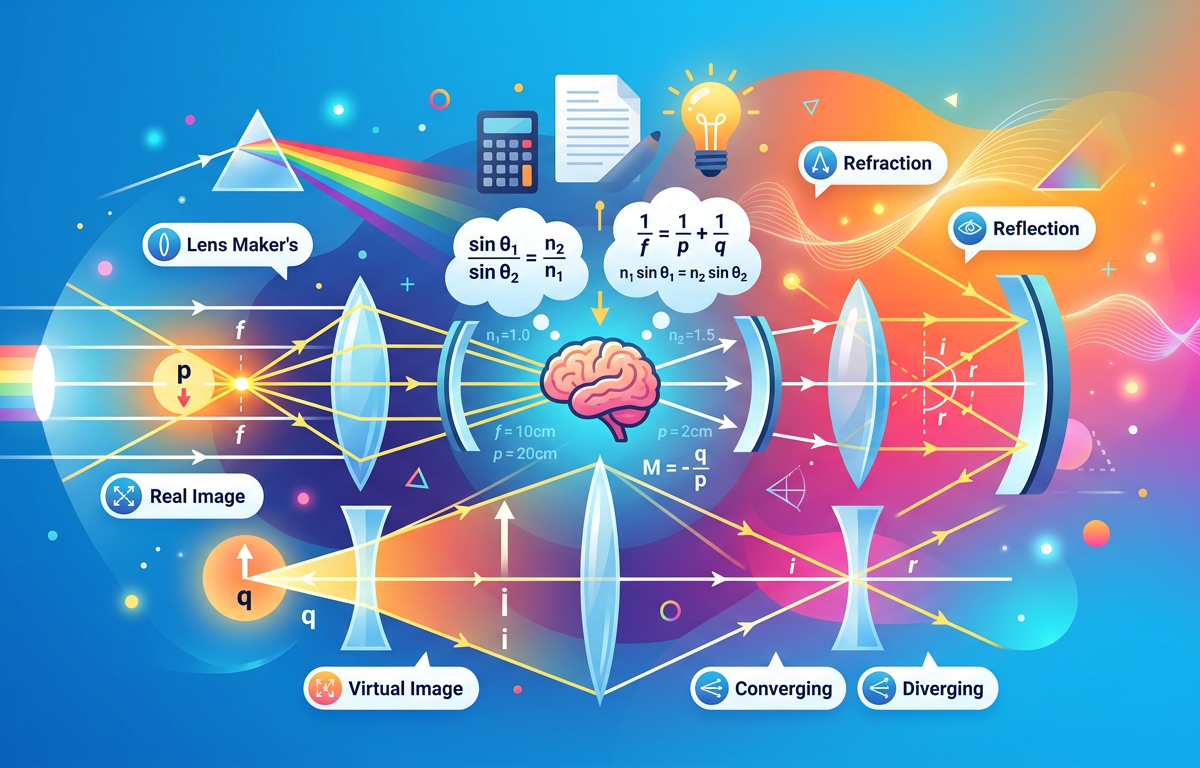
Optics is the branch of physics that studies the behavior and properties of light, including its interactions with matter and the construction of instruments that use or detect it. For the MCAT, optics is generally divided into geometric optics (lenses and mirrors) and wave optics (interference and diffraction). Geometrical optics relies on the ray approximation, where light travels in straight lines until it hits a boundary. Key principles include the Law of Reflection, where the angle of incidence equals the angle of reflection, and Snell’s Law, which describes refraction as light passes between media of different indices of refraction. Snell's Law is expressed as .
Lenses and mirrors are categorized as either converging or diverging. Converging systems (convex lenses and concave mirrors) can form both real and virtual images, while diverging systems (concave lenses and convex mirrors) always form virtual, upright, and reduced images. The thin lens equation, , allows us to calculate the position of an image relative to the focal length () and object distance (). Additionally, the magnification equation tells us if an image is enlarged, reduced, upright, or inverted. For more practice on foundational physical chemistry concepts, check out our Easy MCAT Kinetics Practice Questions.
Solved Examples
- Refraction Calculation: A ray of light travels from air () into a glass block with an index of refraction of 1.5. If the angle of incidence is , what is the sine of the angle of refraction?
- Identify the knowns: , , and .
- Apply Snell's Law:
- Substitute the values:
- Since , the equation becomes .
- Divide by 1.5: .
- Mirror Image Placement: An object is placed 10 cm in front of a concave mirror with a focal length of 5 cm. Where is the image formed?
- Identify the variables: , .
- Use the mirror equation:
- Substitute:
- Subtract from both sides:
- The image is formed at .
- Lens Power: A corrective lens has a focal length of -0.5 meters. What is the power of this lens in diopters?
- Recall the formula for power: (where is in meters).
- Substitute the value:
- Calculate: . This indicates a diverging lens, typically used to correct myopia.
Practice Questions
1. Light travels from a medium with a high refractive index to one with a lower refractive index. If the angle of incidence is increased beyond the critical angle, what phenomenon occurs?
2. A convex mirror always produces what type of image regardless of the object's position?
3. Calculate the index of refraction for a material where the speed of light is . (Note: ).
Track your MCAT progress intelligently.
Use Bevinzey’s analytics and AI-powered feedback to identify weaknesses and improve faster.
See My Progress4. An object is placed 15 cm from a converging lens with a focal length of 10 cm. Is the resulting image real or virtual?
5. Which color of visible light has the shortest wavelength and undergoes the most refraction when passing through a prism?
6. If an image has a magnification of -2.5, what can be concluded about the image's orientation and size?
7. A ray of light strikes a flat mirror at an angle of relative to the normal. What is the angle between the incident ray and the reflected ray?
8. What is the focal length of a plane mirror?
9. A magnifying glass uses a single lens to create an enlarged, upright, virtual image. What type of lens is being used?
10. If the radius of curvature of a spherical mirror is 20 cm, what is its focal length?
Answers & Explanations
- Total Internal Reflection: When light moves from a more dense medium to a less dense medium (higher to lower ) and the angle exceeds the critical angle, the light is entirely reflected back into the first medium. This is the principle behind fiber optics, as described on Wikipedia.
- Virtual, Upright, and Reduced: Convex mirrors are diverging systems. Diverging systems (including concave lenses) can only produce images that are virtual (negative ), upright (positive magnification), and smaller than the object.
- : The index of refraction is defined as . Here, .
- Real: Since the object is placed outside the focal length () of a converging lens, the light rays will converge on the opposite side of the lens, forming a real image. If it were inside the focal length, it would be virtual. This logic is similar to identifying patterns in Easy MCAT Organic Chemistry Practice Questions.
- Violet: In the visible spectrum, violet light has the shortest wavelength and highest frequency. Because the index of refraction generally increases as wavelength decreases (dispersion), violet light bends the most.
- Inverted and Enlarged: A negative magnification sign indicates the image is inverted. An absolute value greater than 1 () indicates the image is larger than the object.
- : The Law of Reflection states the angle of incidence equals the angle of reflection (). The total angle between the two rays is the sum: .
- Infinity: A plane mirror is effectively a spherical mirror with an infinite radius of curvature. Therefore, its focal length is also considered infinite, meaning it does not converge or diverge light to a specific point.
- Convex (Converging) Lens: To get an enlarged virtual image, the object must be placed within the focal length of a converging lens. A diverging lens only produces reduced virtual images.
- 10 cm: For spherical mirrors, the focal length is half of the radius of curvature (). Thus, .
1. Which of the following describes the image formed by a concave lens?
Frequently Asked Questions
What is the difference between a real image and a virtual image?
A real image is formed when light rays actually converge at a point, meaning it can be projected onto a screen. A virtual image occurs where light rays only appear to originate from a point, and it cannot be projected onto a screen.
How does the focal length change for a diverging lens?
By convention, the focal length for any diverging system, such as a concave lens or a convex mirror, is always treated as a negative value in the thin lens equation. This reflects the fact that the virtual focus is on the same side as the incoming light for mirrors or the opposite side for lenses.
What is dispersion in optics?
Dispersion is the phenomenon where the phase velocity of a wave depends on its frequency, causing different colors of light to separate when passing through a medium like a glass prism. This occurs because the index of refraction is slightly different for different wavelengths of light, as explained by Khan Academy.
What is the critical angle?
The critical angle is the specific angle of incidence that results in an angle of refraction of , causing the light to travel along the boundary between two media. It only occurs when light travels from a higher refractive index to a lower one.
Why does light bend when it enters a new medium?
Light bends because its speed changes when it enters a medium with a different optical density. This change in speed causes the wavefronts to pivot, changing the direction of travel unless the light enters at exactly to the normal. For more on how molecular properties affect physical behavior, see our Easy MCAT Gas Laws Practice Questions.
Track your MCAT progress intelligently.
Use Bevinzey’s analytics and AI-powered feedback to identify weaknesses and improve faster.
See My ProgressReviewed by
Michael Danquah, MS, PhD
Dr. Michael Danquah is a professor of pharmaceutical sciences and founder of several educational technology platforms focused on improving student learning and performance.
Enjoyed this article?
Share it with others who might find it helpful.
Related Articles
Hard MCAT Optics Practice Questions
Hard MCAT Optics Practice Questions
May 17, 2026
Medium MCAT Optics Practice Questions
Medium MCAT Optics Practice Questions
May 17, 2026

Hard MCAT Thermodynamics Practice Questions
Hard MCAT Thermodynamics Practice Questions
May 17, 2026
Hard MCAT Kinematics Practice Questions
Hard MCAT Kinematics Practice Questions
May 17, 2026
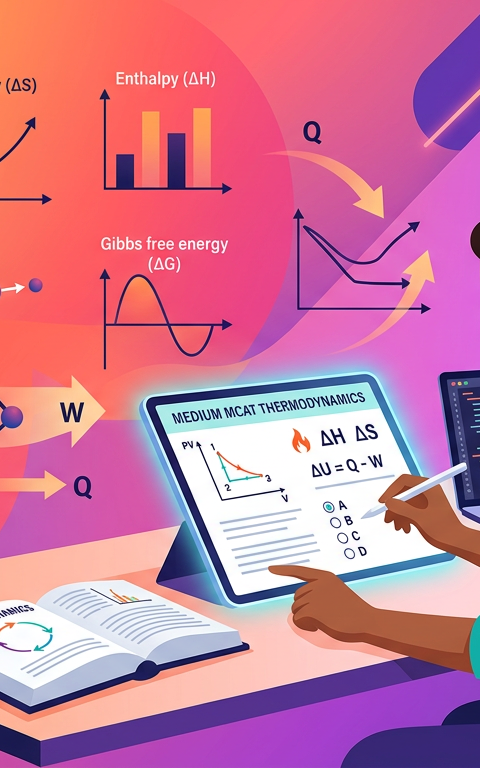
Medium MCAT Thermodynamics Practice Questions
Master thermodynamics with medium-level MCAT practice questions covering Gibbs Free Energy, enthalpy, entropy, and the laws of thermodynamics with full explanations.
May 17, 2026
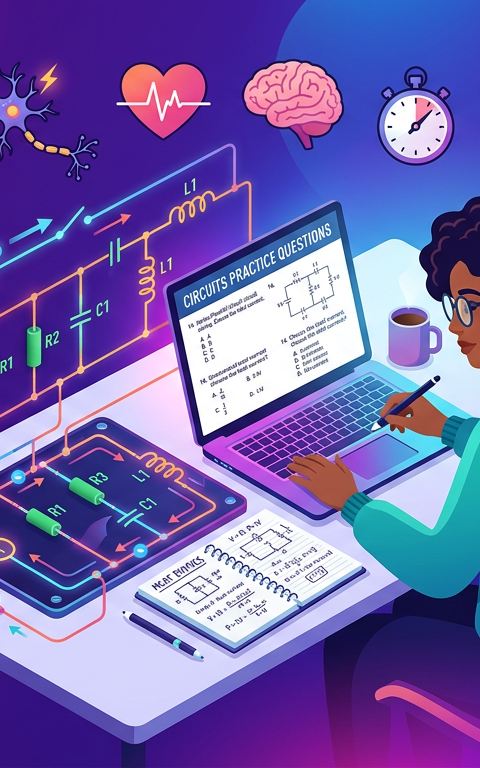
Medium MCAT Circuits Practice Questions
Medium MCAT Circuits Practice Questions
May 17, 2026
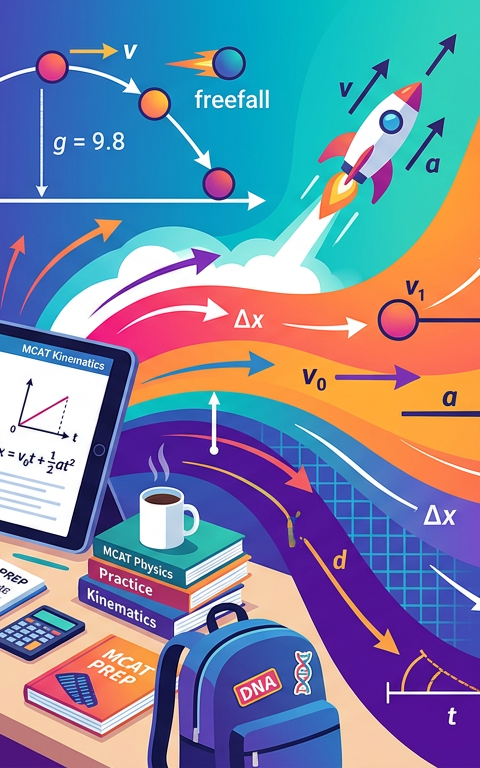
Medium MCAT Kinematics Practice Questions
Medium MCAT Kinematics Practice Questions
May 17, 2026
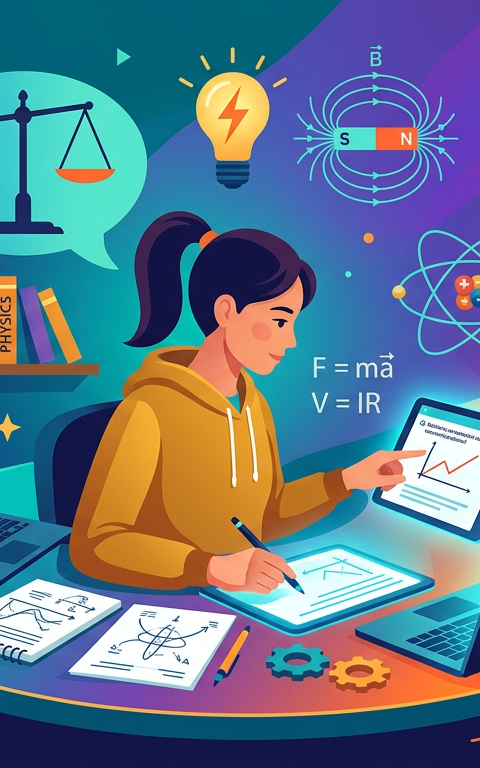
Medium MCAT Physics Practice Questions
Master medium-level MCAT physics with our comprehensive guide featuring solved examples, practice questions, and detailed explanations of core concepts.
May 17, 2026