Easy MCAT Genetics Practice Questions

Easy MCAT Genetics Practice Questions
Mastering basic heredity and molecular biology is a fundamental step for any pre-medical student, and working through Easy MCAT Genetics Practice Questions is the most efficient way to build a solid foundation. Genetics accounts for a significant portion of the Biological and Biochemical Foundations of Living Systems section, requiring you to understand everything from Mendelian inheritance to the intricacies of DNA replication. By using retrieval practice, you can move beyond passive reading and ensure that these core concepts are accessible during the high-pressure environment of the actual exam.
Concept Explanation
Genetics is the study of heredity and the variation of inherited characteristics, focusing on how genetic information is stored, transmitted, and expressed in living organisms. At the MCAT level, this involves understanding the structure of DNA, the mechanisms of the Central Dogma (transcription and translation), and the patterns of inheritance first described by Gregor Mendel. For instance, the Nature Education Scitable provides excellent depth on how mutations occur during replication, which is a key topic for easy MCAT genetics practice questions.
Key concepts include:
- Genotype vs. Phenotype: The genotype is the specific allelic makeup (e.g., ), while the phenotype is the observable physical trait.
- Mendelian Laws: The Law of Segregation states that alleles separate during gamete formation, and the Law of Independent Assortment states that genes for different traits segregate independently.
- Hardy-Weinberg Equilibrium: A mathematical model used to calculate allele frequencies in a non-evolving population using the equation .
- Linkage: Genes located close together on the same chromosome are less likely to be separated by crossing over during meiosis.
To excel, students should integrate these concepts with their knowledge of cell biology and biochemistry. Understanding how a single nucleotide change can lead to a different protein structure is a classic example of how genetics bridges the gap between molecules and whole-organism physiology.
Solved Examples
Example 1: Monohybrid Cross
A homozygous dominant pea plant with purple flowers () is crossed with a homozygous recessive plant with white flowers (). What is the genotypic ratio of the F2 generation?
- Identify the F1 generation: Crossing yields 100% (heterozygous) offspring.
- Perform the F2 cross: Cross two F1 plants ().
- Set up a Punnett square: The possible combinations are , , , and .
- Calculate the ratio: The genotypic ratio is 1:2:1 (1 , 2 , 1 ).
Example 2: Hardy-Weinberg Calculation
In a population in Hardy-Weinberg equilibrium, the frequency of a recessive allele () is 0.3. What is the frequency of the heterozygous genotype?
- Identify the given value: .
- Find the dominant allele frequency (): Since , then .
- Apply the genotype frequency formula: The frequency of heterozygotes is .
- Calculate: . The frequency is 42%.
Example 3: X-Linked Inheritance
A color-blind man () marries a woman who is a carrier for color-blindness (). What is the probability that their first son will be color-blind?
- Determine the gametes: The father provides or . The mother provides or .
- Identify the offspring that are male: Sons receive the chromosome from the father.
- Analyze the maternal contribution to sons: The mother can give either (normal vision) or (color-blind).
- Conclude the probability: Since the son must receive the from the father, his vision depends entirely on which he gets from his mother. There is a 50% chance he receives .
Practice Questions
1. Which of the following describes a test cross used to determine the genotype of an individual displaying a dominant phenotype?
2. If a DNA strand has the sequence , what is the sequence of the complementary RNA strand produced during transcription?
3. In a dihybrid cross between two individuals heterozygous for both traits (), what is the expected phenotypic ratio assuming independent assortment?
Need more MCAT practice questions?
Generate unlimited MCAT-style questions with instant explanations and adaptive practice powered by Bevinzey AI.
Generate Questions Free4. Which phase of meiosis is most responsible for the Law of Independent Assortment?
5. A researcher observes that two genes are inherited together 95% of the time. What does this suggest about their physical location on the chromosome?
6. If the guanine content of a double-stranded DNA molecule is 20%, what is the adenine content?
7. Which type of mutation results in the substitution of one amino acid for another in the final protein product?
8. Define the term "hemizygous" in the context of human genetics.
9. A population of rabbits has 16% white fur (a recessive trait). Assuming Hardy-Weinberg equilibrium, what is the frequency of the dominant allele?
10. What is the primary difference between a nucleoside and a nucleotide?
Answers & Explanations
1. Answer: Crossing the individual with a homozygous recessive individual. To determine if a dominant phenotype is or , you cross it with . If any offspring show the recessive phenotype, the parent was . If all offspring show the dominant phenotype, the parent was likely .
2. Answer: (or ). Transcription produces an RNA strand antiparallel to the DNA template. DNA pairs with RNA , with , with , and with . Note the polarity of the strands.
3. Answer: 9:3:3:1. This is the classic Mendelian ratio for a dihybrid cross where 9 individuals show both dominant traits, 3 show the first dominant/second recessive, 3 show the first recessive/second dominant, and 1 shows both recessive traits.
4. Answer: Metaphase I. During Metaphase I, homologous chromosome pairs line up randomly at the metaphase plate. The orientation of one pair does not affect the orientation of another, which is the physical basis of independent assortment.
5. Answer: The genes are linked and located very close to each other. A high frequency of co-inheritance (and low recombination frequency of 5%) indicates that the genes are physically close on the same chromosome, making crossing over between them rare.
6. Answer: 30%. According to Chargaff's rules, and . If , then . Together they make up 40%. The remaining 60% is split equally between and , so .
7. Answer: Missense mutation. A missense mutation is a point mutation where a single nucleotide change results in a codon that codes for a different amino acid. This is distinct from a nonsense mutation, which creates a premature stop codon.
8. Answer: Having only one copy of a gene or chromosome. In humans, males are hemizygous for most genes on the X and Y chromosomes because they only possess one of each, unlike females who have two X chromosomes.
9. Answer: 0.6. The frequency of the recessive phenotype () is 0.16. Therefore, . Since , the frequency of the dominant allele .
10. Answer: The presence of a phosphate group. A nucleoside consists of a nitrogenous base and a pentose sugar. A nucleotide is a nucleoside with one or more phosphate groups attached to the sugar.
1. Which nitrogenous base is found in RNA but not in DNA?
Frequently Asked Questions
What is the difference between an allele and a gene?
A gene is a specific sequence of DNA that codes for a protein or trait, while an allele is a specific variant or version of that gene. For example, the gene for eye color may have different alleles for blue or brown eyes.
How do I identify an X-linked recessive trait on the MCAT?
Look for patterns where the trait appears much more frequently in males than in females. Additionally, an affected father will never pass the trait to his son, but all of his daughters will be carriers.
What is incomplete dominance?
Incomplete dominance occurs when the phenotype of a heterozygote is an intermediate blend of the two homozygous phenotypes. A classic example is a red flower and a white flower producing pink offspring.
Why is the Hardy-Weinberg principle useful for the MCAT?
It allows test-takers to calculate allele and genotype frequencies within a population. This provides a mathematical way to study evolution by determining if frequencies are changing over time.
What is the role of DNA Ligase?
DNA Ligase is the enzyme that joins DNA fragments together, specifically by creating phosphodiester bonds. It is essential for sealing Okazaki fragments on the lagging strand during DNA replication.
Can mutations be beneficial?
Yes, while many mutations are neutral or harmful, some provide a selective advantage in a specific environment. These beneficial mutations are the driving force behind natural selection and evolution.
Need more MCAT practice questions?
Generate unlimited MCAT-style questions with instant explanations and adaptive practice powered by Bevinzey AI.
Generate Questions FreeReviewed by
Michael Danquah, MS, PhD
Dr. Michael Danquah is a professor of pharmaceutical sciences and founder of several educational technology platforms focused on improving student learning and performance.
Enjoyed this article?
Share it with others who might find it helpful.
Related Articles

Applying Coulomb’s Law and Potential to MCAT Biological Systems
MCAT Electrostatics Practice Questions with Answers
May 14, 2026
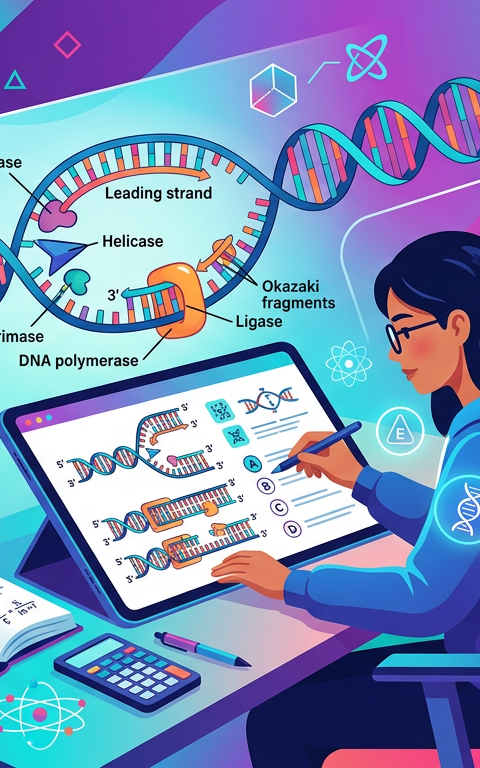
Hard MCAT DNA Replication Practice Questions
Master high-level DNA replication concepts with these hard MCAT practice questions covering enzymes, directionality, and telomeres.
May 14, 2026
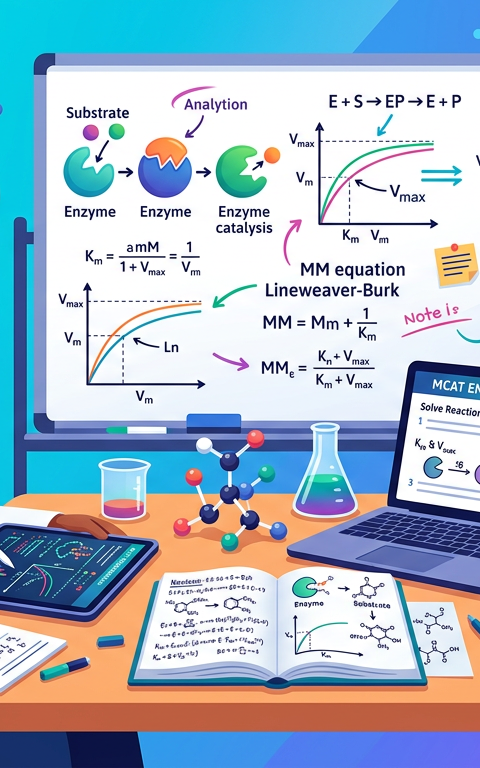
Hard MCAT Enzyme Practice Questions
Hard MCAT Enzyme Practice Questions
May 14, 2026
Medium MCAT DNA Replication Practice Questions
Medium MCAT DNA Replication Practice Questions
May 14, 2026

Medium MCAT Enzyme Practice Questions
Medium MCAT Enzyme Practice Questions
May 14, 2026

Easy MCAT DNA Replication Practice Questions
Master DNA replication with these easy MCAT practice questions. Learn about helicase, polymerase, and semi-conservative replication with detailed explanations.
May 14, 2026

MCAT Enzyme Kinetics: Solving KM and Vmax Without a Calculator
Easy MCAT Enzyme Practice Questions
May 14, 2026
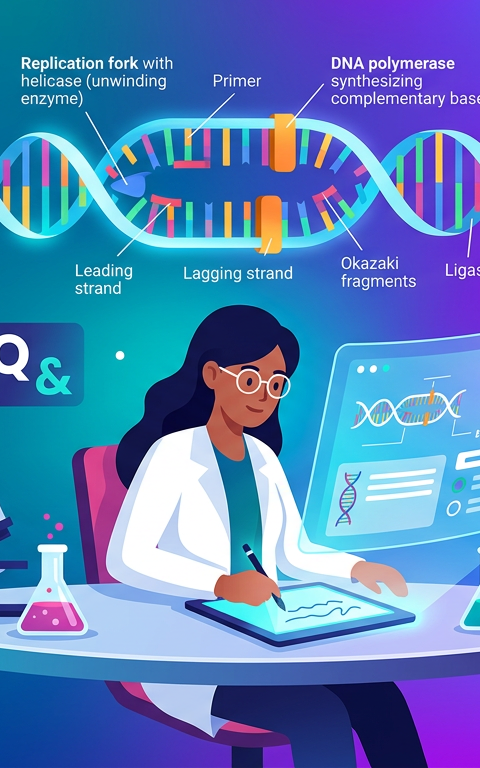
MCAT DNA Replication Practice Questions with Answers
MCAT DNA Replication Practice Questions with Answers
May 14, 2026