Easy Calorimetry Practice Questions
Concept Explanation
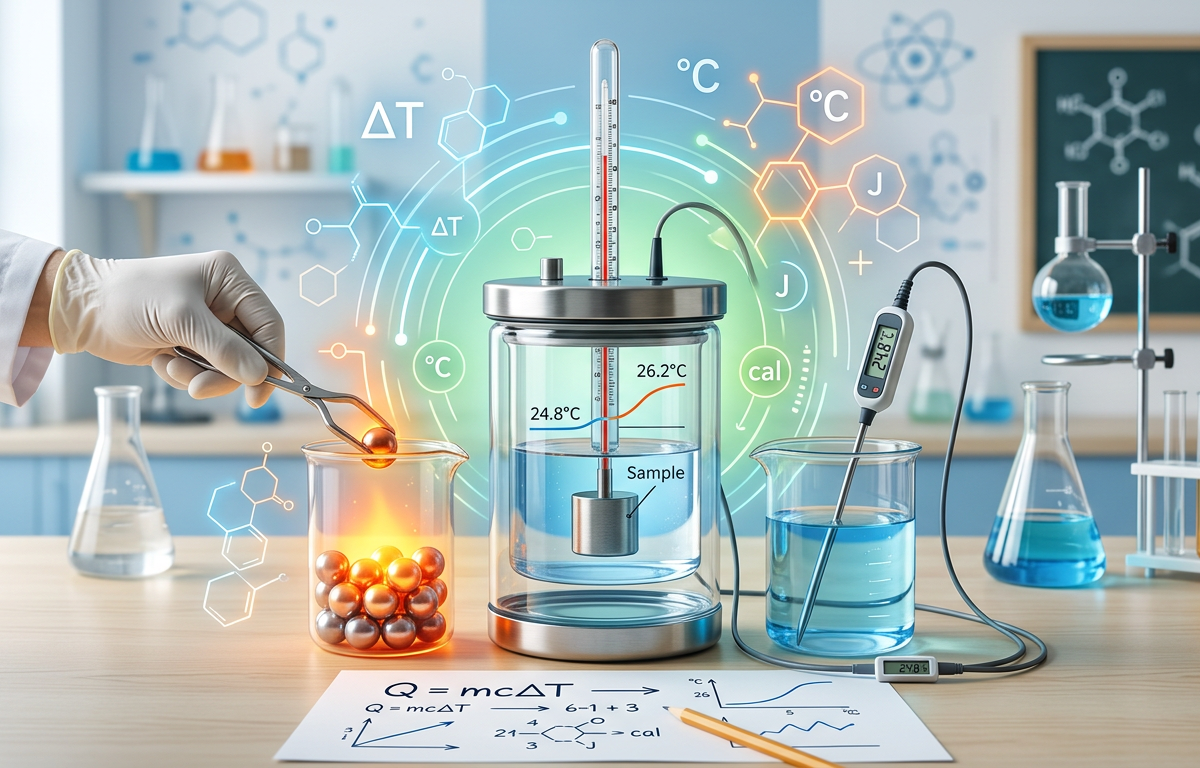
Calorimetry is the experimental technique used to measure the amount of heat energy transferred into or out of a system during a chemical reaction or physical process. By monitoring temperature changes in a controlled environment, scientists can determine how much energy is absorbed or released. This process relies on the Law of Conservation of Energy, which states that energy cannot be created or destroyed, only transferred. In a typical laboratory setup, a calorimeter acts as an insulated container that prevents heat exchange with the outside environment, ensuring that the heat lost by a substance is equal to the heat gained by the surroundings (usually water).
To solve easy calorimetry practice questions, you must master the fundamental heat transfer equation: q = m × c × ΔT. In this formula, q represents the heat energy (measured in Joules), m is the mass of the substance (in grams), c is the specific heat capacity (the energy required to raise one gram by one degree Celsius), and ΔT is the change in temperature (calculated as Final Temperature - Initial Temperature). For example, the specific heat of liquid water is a constant 4.184 J/g°C. Understanding this relationship is a prerequisite for more advanced topics like enthalpy change calculations and heat of reaction analysis.
Solved Examples
Review these step-by-step solutions to understand how to apply the calorimetry formula in different scenarios.
Calculating Heat Absorbed: How much heat is required to raise the temperature of 50.0 g of water from 20.0°C to 45.0°C? (Specific heat of water = 4.184 J/g°C).
Identify the knowns: m = 50.0 g, c = 4.184 J/g°C, ΔT = 45.0 - 20.0 = 25.0°C.
Apply the formula: q = m × c × ΔT.
Calculate: q = (50.0 g)(4.184 J/g°C)(25.0°C) = 5,230 Joules.
Finding Specific Heat: A 100.0 g piece of an unknown metal releases 1,200 J of heat as it cools from 80.0°C to 50.0°C. What is the specific heat of the metal?
Identify the knowns: m = 100.0 g, q = -1,200 J (heat is released), ΔT = 50.0 - 80.0 = -30.0°C.
Rearrange the formula: c = q / (m × ΔT).
Calculate: c = -1,200 / (100.0 × -30.0) = 0.40 J/g°C.
Determining Final Temperature: If 2,000 J of heat is added to 150 g of water at 25.0°C, what is the final temperature?
Identify the knowns: q = 2,000 J, m = 150 g, c = 4.184 J/g°C, T_initial = 25.0°C.
Solve for ΔT: ΔT = q / (m × c) = 2,000 / (150 × 4.184) ≈ 3.2°C.
Calculate T_final: T_final = T_initial + ΔT = 25.0 + 3.2 = 28.2°C.
Practice Questions
Test your knowledge with these easy calorimetry practice questions. Ensure you have a calculator and a periodic table handy if needed.
1. A 25.0 g sample of aluminum (c = 0.897 J/g°C) is heated from 15.0°C to 40.0°C. How much heat energy did the aluminum absorb?
2. Calculate the mass of a water sample that absorbs 8,368 J of energy when its temperature increases by 10.0°C.
3. An unknown substance with a mass of 10.0 g requires 50.0 J of heat to raise its temperature by 5.0°C. What is its specific heat capacity?
Want unlimited practice questions like these?
Generate AI-powered questions with step-by-step solutions on any topic.
Try Question Generator Free →4. A 500 g block of iron (c = 0.449 J/g°C) cools from 100°C to 20°C. How much heat is released into the surroundings?
5. If 1,500 J of heat is applied to a 30.0 g sample of copper (c = 0.385 J/g°C) at 22.0°C, what will the final temperature be?
6. 100.0 g of water at 90.0°C is mixed with 100.0 g of water at 10.0°C in a perfect calorimeter. What is the final temperature of the mixture?
7. A 200.0 g sample of silver absorbs 472 J of heat, causing the temperature to rise by 10.0°C. Calculate the specific heat of silver.
8. How much energy in kilojoules (kJ) is needed to heat 1.0 kg of water from boiling point (100°C) to 25°C? (Note: Think about the direction of heat flow).
9. A coffee-cup calorimeter contains 150.0 g of water at 23.0°C. After a chemical reaction occurs, the temperature rises to 28.5°C. How much heat was released by the reaction?
10. Which material will undergo a larger temperature change if the same amount of heat is added to 10g of each: Water (c = 4.184 J/g°C) or Gold (c = 0.129 J/g°C)?
Answers & Explanations
1. 560.6 J. Using q = mcdT: q = 25.0 g × 0.897 J/g°C × (40.0 - 15.0)°C = 560.625 J. Rounding to significant figures gives 561 J or 560.6 J.
2. 200 g. Rearrange to m = q / (c × ΔT). m = 8368 / (4.184 × 10.0) = 8368 / 41.84 = 200 g. This demonstrates the high heat capacity of water compared to metals.
3. 1.0 J/g°C. Use c = q / (m × ΔT). c = 50.0 / (10.0 × 5.0) = 50.0 / 50.0 = 1.0 J/g°C.
4. -17,960 J (or 17.96 kJ released). q = 500 × 0.449 × (20 - 100). q = 500 × 0.449 × -80 = -17,960 J. The negative sign indicates an exothermic process.
5. 151.9°C. First find ΔT: ΔT = 1500 / (30.0 × 0.385) = 1500 / 11.55 ≈ 129.9°C. Final T = 22.0 + 129.9 = 151.9°C.
6. 50.0°C. Since the masses and specific heats are identical, the final temperature is the simple average: (90 + 10) / 2 = 50.0°C. This is a common calorimetry practice question scenario.
7. 0.236 J/g°C. c = 472 / (200.0 × 10.0) = 472 / 2000 = 0.236 J/g°C.
8. -313.8 kJ. m = 1000 g, ΔT = 25 - 100 = -75°C. q = 1000 × 4.184 × -75 = -313,800 J. Convert to kJ by dividing by 1000.
9. 3,452 J. q_water = 150.0 × 4.184 × (28.5 - 23.0) = 150.0 × 4.184 × 5.5 = 3,451.8 J. Since the water gained heat, the reaction released 3,452 J.
10. Gold. Temperature change (ΔT) is inversely proportional to specific heat (c). Since gold has a much lower specific heat, its temperature will spike much faster than water's.
1. What does the variable 'c' represent in the calorimetry equation q = mcΔT?
Frequently Asked Questions
What is the difference between heat and temperature?
Heat is the total energy transferred between objects due to a temperature difference, while temperature is a measure of the average kinetic energy of the particles in a substance. You can think of heat as the flow of energy and temperature as the "thermal level" of the object.
Why is water commonly used in calorimeters?
Water is used because it has a very high specific heat capacity, meaning it can absorb or release large amounts of heat with relatively small changes in temperature. This makes it an excellent medium for insulating reactions and providing accurate measurements in a coffee-cup calorimeter.
Can ΔT be negative in calorimetry calculations?
Yes, ΔT is negative whenever a substance cools down, as the final temperature is lower than the initial temperature. A negative ΔT results in a negative value for q, which signifies that heat is being released by the system into the surroundings.
What is a coffee-cup calorimeter?
A coffee-cup calorimeter is a simple constant-pressure calorimeter made from nested Styrofoam cups that minimize heat exchange with the air. It is frequently used in student laboratories to measure the heat of aqueous reactions or the specific heat of metals.
How do I convert between Joules and Calories?
The conversion factor is 1 calorie (cal) = 4.184 Joules (J). Note that nutritional Calories (with a capital C) are actually kilocalories, so 1 Calorie = 1,000 calories = 4,184 Joules.
Want unlimited practice questions like these?
Generate AI-powered questions with step-by-step solutions on any topic.
Try Question Generator Free →
Want unlimited practice questions like these?
Generate AI-powered questions with step-by-step solutions on any topic.
Try Question Generator Free →Enjoyed this article?
Share it with others who might find it helpful.
Related Articles
Hard Le Chatelier’s Principle Practice Questions
Master Hard Le Chatelier’s Principle Practice Questions with our comprehensive guide featuring solved examples, practice problems, and detailed explanations.
Mar 30, 2026
Hard Reaction Quotient (Q) Practice Questions
Hard Reaction Quotient (Q) Practice Questions
Mar 30, 2026
Grams to Moles Practice Questions with Answers
Master grams to moles conversions with our comprehensive guide. Includes step-by-step examples, practice questions, and detailed answers for chemistry students.
Mar 26, 2026
Avogadro’s Number Practice Questions with Answers
Master the mole concept with our Avogadro’s Number practice questions. Includes step-by-step solved examples, a quick quiz, and detailed explanations.
Mar 26, 2026
Empirical Formulas: Solving Ratios from Mass and Percent Data
Master empirical formula calculations with 10 practice questions, worked answers, and a free step-by-step calculator for mass, percentage, and combustion problems.
Mar 26, 2026